Bootnecking Modern Civilization
Modern civilization lifted nature’s boot off humanity’s neck.
Nature’s boot, to put it simply, is the harsh struggle to exist. In nature, most organisms die without reproducing. That is necessary to prevent populations from exploding. It is not the design of a benevolent creator. It is just how things happen: populations increase until competition limits them.
All species have the capacity for excess reproduction, so all species have the capacity for exponential growth. No species could evolve without that capacity. So, there must be an opposing force that prevents populations from growing to infinity. The opposing force is competition for finite resources. Increased population causes increased competition, which causes increased premature death. In an equilibrium state, excess reproduction is balanced by premature death. Life is a harsh struggle to exist.
In modern civilization, most children live to adulthood. Life is not a desperate struggle to survive. Life is relatively easy. The boot is gone, for now.
The absence of nature’s boot creates new problems. These new problems are counter-intuitive, because the human brain is adapted to the boot. Somewhat ironically, the brain doesn’t work without the boot. The brain was smart enough to wriggle free of the boot, but it isn’t smart enough to figure out how live without the boot.
Or so it seems.
For humanity as a whole, the absence of the boot creates the twin biological problems of population growth and dysgenics. The boot regulated the human population and genome. Without the boot, the population is growing, and the genome is degrading.
The solution to these problems is simple: replace nature’s boot with eugenic reproduction control. However, most people reject this solution, because they don’t understand the problem. They don’t understand how making life easier for human beings could cause problems. It is counter-intuitive.
In the past, we solved problems by pushing against nature’s boot. It is hard to understand that the absence of the boot creates new problems, which can only be solved with a new boot.
For humans, the struggle to exist often involves war. We compete for resources as groups. Our ancestors solved problems of scarcity by killing other people and taking their land. It is natural for humans to go to war. It is not natural for humans to regulate their own populations. Population growth naturally led to war, which reduced the population.
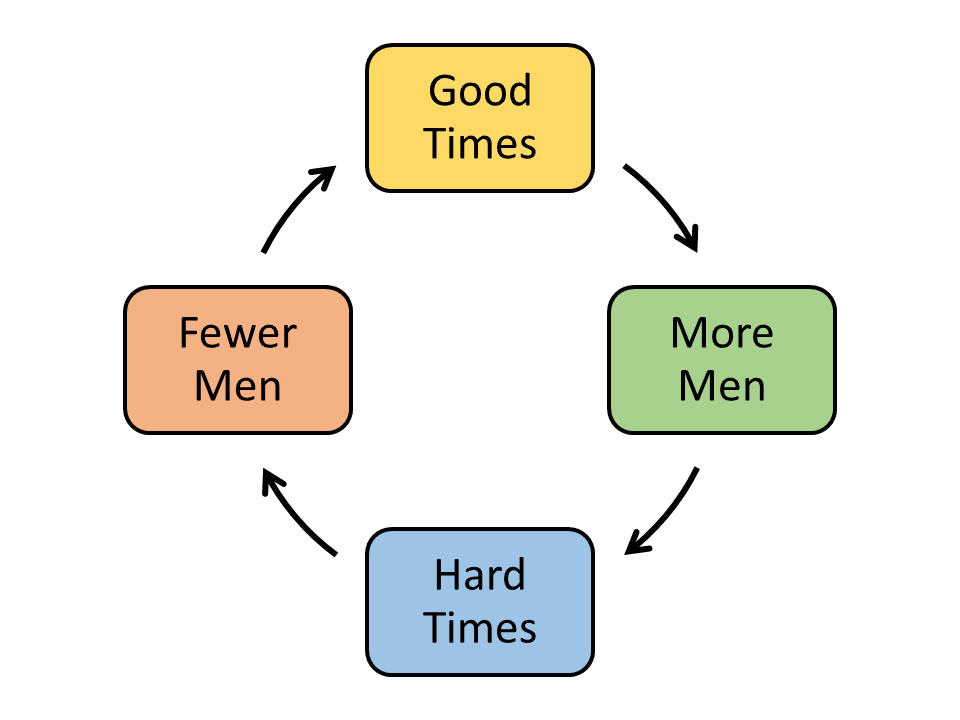
Occasionally, humans discover a new trick, such as agriculture or fossil fuels. Then the population increases for a while, until it reaches a new limit. In some cases, the population overshoots the limit and then collapses.
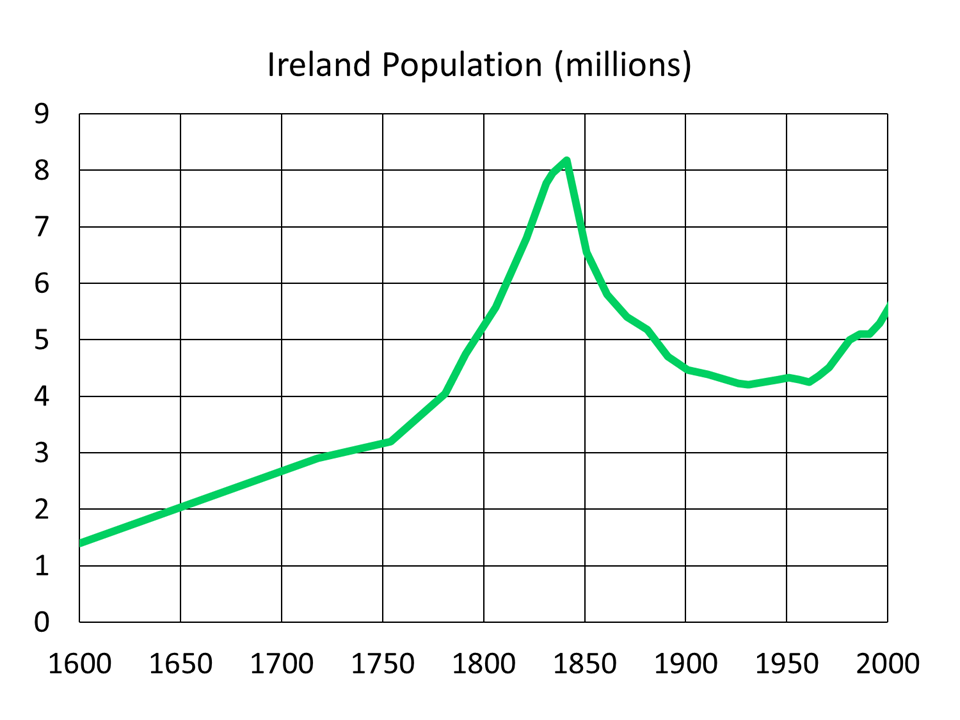
The 1845–1852 famine in Ireland is a good example of the boom-and-bust population cycle. The potato is native to South America. It was introduced to Ireland in the 1600s. By 1750, it had become a staple crop. The new food source created temporary abundance. The Irish population grew rapidly, from about 3 million in 1750 to over 8 million in 1845. Then, when food was already scarce, a disease affected the potato crop, causing bad harvests. The result was mass starvation and a rapid population decline.
Good times are transient and self-eliminating. Hard times are relatively stable.
Now is a good time. We currently have abundance, not scarcity. Most children live to adulthood. The problems of the past have disappeared, for now. So, it is hard for people to understand that there is any problem that needs solving.
We evolved to deal with scarcity by competing for resources. We did not evolve to perpetuate abundance by regulating our population. Likewise, we never regulated our genome in the past — at least, not deliberately. So, the idea of regulating our population and genome seems strange to most people.
Nature’s boot solved the problems of population growth and dysgenics by killing children. We have never solved those problems for ourselves.
I am not proposing that we solve our problems by killing children. We can replace nature’s boot with socially imposed reproduction control, which is a much gentler boot.
But we don’t seem capable of understanding our new problems, let alone solving them. So, nature’s boot will probably return in the not-too-distant future.
The absence of the boot also creates psychological and philosophical problems for individuals. It makes human emotions dysfunctional, and it creates the need for an explicit purpose.
When the boot is on the neck, human emotions work properly. They cause us to struggle to survive. That’s what we evolved to do, and our emotions evolved to make us do it. Once the boot comes off the neck, human emotions become dysfunctional.
For example, women evolved to depend on men for survival. Men have a stronger sexual attraction toward women than vice versa, because women needed male protection and support, and/or because women didn’t always have the option to refuse sex. Hunger, danger and coercion forced women to mate with men. In modern civilization, those ancestral forces are no longer present. The result is a breakdown in human sexual behavior. Men and women are not forming relationships and having sex.
I am not proposing that women be placed in conditions of hardship and danger, so that they submit sexually to men. But we need to understand that human emotions are adapted to the conditions of the past, not to the conditions of the modern world. If we want a civilization in which women are safe and comfortable (as I do), then we need to make women depend on men in other ways, to restore a balance of power between the sexes.
Birth control is another solution that creates new problems. It gives us a new type of agency: the ability to control reproduction without abstinence. Birth control is not harmful per se. It gives us more control over our lives. However, we did not evolve to have this type of agency. With easy access to birth control, most people choose to have few or no children.
In a world with birth control, human beings need to explicitly value reproduction. Otherwise, many will not reproduce, and they will not have a unifying purpose of life. They will just spin their wheels until they die.
This is where many people (understandably) get confused. Earlier, I said that unregulated reproduction is a problem. Birth control allows people to regulate reproduction. So, it seems that birth control solves the problem that I raised before. It replaces nature’s boot. Thus, there is nothing to worry about, right?
Wrong. Things aren’t that simple.
Voluntary low fertility is not a substitute for nature’s boot. It is dysgenic, not eugenic. It is also self-eliminating. In the long run, genes and memes that cause high fertility will replace those that cause low fertility. Even when something is voluntary, it has deterministic causes that can be selected for or against. The population might stop growing temporarily due to voluntary low fertility, but only nature’s boot or socially imposed reproduction control can stop the population from exploding in the long run.
To replace nature’s boot, birth control must be imposed, not voluntary. Otherwise, there is a free-rider problem. Collective problems require social solutions.
See Game Theory and Cooperation, Fertility and Destiny, and Dysgenics, Overpopulation and Conventional Ignorance.
Modern civilization causes a loss of purpose for many individuals. They simply don’t know what to do with their lives. In the past, people couldn’t choose careers, lifestyles, genders, sexualities, etc. Those things were mostly determined by culture or nature. Women would get pregnant soon after puberty, so they needed to be married. People knew what to do: struggle to survive and raise their children. Today, people have choices that they didn’t evolve to make, and they don’t have the problems that they evolved to solve. They are lost, confused, and spinning their wheels. They don’t know what to do.
That is one reason for the explosion of new ideologies and identities, such as transgenderism. There is a deep sense that something is wrong with modern life. The real problem is counter-intuitive, so people don’t see it. Instead, they frantically search for meaning in other areas.
To behave adaptively in the modern world, the individual must reject hedonism and explicitly value reproduction. In the past, human emotions caused people to reproduce without the conscious choice to reproduce. Now that we have the ability to control our reproduction, as individuals, we must choose to reproduce. The explicit value of reproduction is a substitute for nature’s boot. It gives the individual a purpose: something to work toward.
The individual needs a new struggle to replace the old struggle against nature’s boot. This struggle requires two things:
- An explicit purpose of life: reproduction
- Society making that purpose harder to attain
The individual needs to explicitly value reproduction. Society should place legal restrictions on reproduction. Society should require that both parents are law-abiding, productive members of society, who have the means to support their children at a level deemed adequate. Society should also impose the requirement that both parents agree to have a child.
The explicit purpose of reproduction would make the individual more adapted to the modern environment. The social regulation of reproduction would be a substitute for nature’s boot. It would solve the collective problems of dysgenics and population growth. It would help to restore the balance between the sexes, because a woman would need a man to have a child. It would also solve the crisis of meaning, by giving the individual a meaningful struggle.
Again, this is counter-intuitive. There is a cultural assumption that society should help the individual, not make life more difficult for him. But we need society to create artificial scarcity of a critical resource, both to regulate reproduction and to give the individual a new struggle.
Modern civilization has lifted nature’s boot off humanity’s neck, but only temporarily, and the absence of the boot has created new problems. To make modern civilization sustainable, we must “bootneck” ourselves.