Easter Island
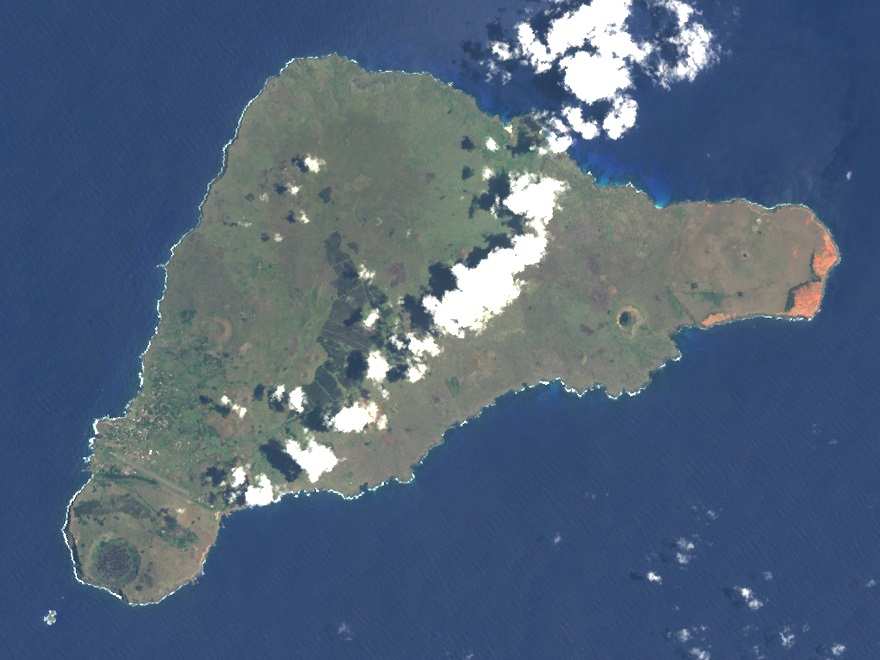
The story of Easter Island has always fascinated me, partly because of the huge, enigmatic statues, but also because Easter Island was (before European contact) a miniature analog to the Earth. It was a little world, isolated in the Pacific, which was colonized by human beings only about 1000 years ago. Within a 500-year period, there was a population explosion, environmental degradation and population collapse. I will retell that story very briefly here. Then I will consider some of its implications for human nature.
The original colonists found a paradise. Food was abundant. They brought no diseases with them. With abundant food and land, there was probably little conflict between them. For many generations, they lived lives free of hunger, disease and war. Naturally, the population grew.
When the colonists first arrived, they could easily kill dolphins and seabirds for food, so they did. The island was covered in a lush forest of huge trees, which could be cut down for canoes or timber. So, the colonists cut them down. Eventually, the dolphins and seabirds disappeared, so the Easter Islanders switched to agriculture as their main source of food.
As their population expanded, they spread over the island, and formed different clans in different areas. Those clans seem to have lived together in peace, as they traded resources and probably mates with each other. The human population continued to grow. Eventually it reached a peak of 15,000 or more, all descended from a few original colonists.
At some point before the peak, the islanders started making giant stone statues. Polynesians have a cultural tradition of building statues and totem poles, but not on that scale or in that peculiar, monotonous style. My guess is that the statues replaced wooden totem poles when wood became scarce, due to the deforestation of the island. The statues probably had some religious significance. They were probably also status symbols. For whatever reason, the islanders built those strange statues for which the island is famous today.
When they reached their peak population, the island had been completely deforested. There were no trees left for building canoes, which they could have used to escape or harvest marine resources. The landscape was badly eroded, and much of the soil had washed into the sea. The next generation was growing up, and it was twice as big as the previous one. They could not expand food production to keep up with population growth. They had finally reached the limited capacity of the island. In fact, food production was declining, due to the degradation of the environment.
In the past, they had always been able to grow their population. When they ran out of one resource, they found another. They probably believed that this could continue forever: that they could always find new resources, and always expand their population. But they had finally reached a limit. There were no new resources.
The islanders could have prevented a catastrophic collapse with self-regulation. If they had controlled their population (deliberately ending growth), they could have maintained their society in a state of peace and prosperity. But that would have required them to change their religious and moral beliefs. Like most people, they probably viewed themselves as semi-divine, and thus above nature. They probably believed that the preceding period of prosperity and growth was due to their semi-divine nature, not to their exploitation of a newly discovered island. To solve their new problem, they would need to understand that they were the cause of it, and not because they had stopped building totem poles, but because their population had exploded.
Instead, they built statues. And then they went to war.
At the height of their statue-building mania, they descended into war and cannibalism. They fought over the precious land on which to grow food. They also fought to obtain the only alternative food available: human meat. They began to eat each other. Cannibalistic warfare literally consumed the islanders, until most of the population was gone. The remnant population lived on, in a state of desperate poverty and endemic warfare, until Europeans showed up. Then things got even worse for most of them.
When Europeans discovered the island, they were amazed by the enigmatic statues. They couldn’t understand how the people of the island, who were few in number and very poor, could have built these strange monuments.
What lessons can we learn from the natural experiment of Easter Island?
The most important lesson is just that human beings are not magic. Our culture has a myth that human nature is essentially rational and altruistic. According to this myth, human nature should generate a utopia of peaceful cooperation. The natural experiment of Easter Island demonstrates otherwise. Isolated in a rich environment, human nature generated runaway growth, environmental degradation and a catastrophic collapse.
Another lesson is that people are often blind to problems created by themselves, and to solutions that require self-regulation.