Ferguson: Race and Violence
Written in August 2014.
The Incident
Michael Brown was an 18-year-old black man who was killed by the police. He was a big guy: 6 feet 4 inches tall and almost 300 pounds. Based on video surveillance, it appears that he robbed a convenience store on the day of his death, stealing cigarillos and pushing the store clerk. Afterward, he was walking down the middle of the street with his friend, when a police officer pulled up behind him and told him to get out of the street. Michael Brown refused. The police officer decided to detain him, either because of his attitude or because he was a suspect in the robbery. A fight ensued. Michael Brown began to flee, but then turned back and was shot 6 times, with one wound being fatal.
That is my understanding of the incident. For the purposes of this essay, the details are not that important, as long as we know what did not happen. The police officer did not shoot Michael Brown just because he was black.
Michael Brown died because of his own bad decisions. He decided to rob a store. He decided to swagger down the middle of the street, rather than walk on the sidewalk. He decided to get into a fight with a cop. As a consequence, he ended up dead.
Was the police officer justified in shooting Michael Brown? Yes and no. He probably could have handled the situation in a different way. However, you can’t expect someone to have perfect judgment in the middle of a violent confrontation, when the adrenaline is flowing. He was clearly justified in stopping Michael Brown and asking him to get off the street. He was not harassing him. He was enforcing the law.
The Aftermath
After the killing of Michael Brown, there were protests and riots. The media played a large role in fanning those flames.
As with the Trayvon Martin case, the left-wing media tried to portray this as an example of police injustice and white racism toward blacks. They tried to fit this incident into the narrative of racial oppression. This is nothing but confirmation bias, or in other words, prejudice. If there was a real pattern of white violence toward young black men, surely they could find better examples than this case and the Trayvon Martin case.
The real story of race and violence in the United States does not fit the racial oppression narrative. A few days ago, a 9-year-old black boy was gunned down in his backyard, execution style, on Chicago’s south side. He was shot 4 times. The response of the left-wing media? Silence. The occasional killing of a black man by a white authority figure generates a media frenzy. The daily killing of blacks by blacks is ignored.
The Michael Brown case is not an instance of a pattern of white on black violence. It is an instance of a pattern of black violent behavior. The violence was initiated by Michael Brown, not the police officer. Blacks are much more likely to commit violent crimes than whites. So, let’s consider the other story, the one that is ignored by the left-wing media: the story of black violence.
Status and Violence
Michael Brown had a lifestyle that would be considered affluent by most people in the world, and by most people throughout history. He was well fed. He had a warm place to sleep. He had a family that loved him. He lived in one of the most prosperous nations in the world and in all of history. He had received a free education up to Grade 12, and he had the opportunity to attend college. If he had been unable to afford food, shelter or medical treatment, the state would have provided those things to him for free. He had the same legal rights as any other citizen. There are even affirmative action policies that gave him an advantage over a white man with equal abilities. Was he oppressed? I don’t think so.
Why did a young man with all these advantages and opportunities choose to rob a convenience store, swagger down the middle of the street, and fight with a cop?
Status. Dominance. Aggression.
When people have their basic needs met, sexual and social drives become their main motivators. For men, status is mostly about dominance. Men compete with men for power within society. Power comes in different forms, but the most obvious form is physical: being strong and dangerous.
Men are biologically driven to compete for dominance with other men. Why? Because dominance gives a man greater access to women and resources, which are necessary to reproduce. Men have been selected to compete for dominance, because being a dominant male was adaptive. By fighting his way to the top, a man could have multiple mates, and father many children. So, men are driven to compete for dominance, and will risk injury or death in that competition.
On the day he died, Michael Brown was acting in a dominant, aggressive way. He went into a store and robbed it by force, not stealth. I’m sure he enjoyed the feeling of power when he pushed around a smaller man and took what he wanted. Then he swaggered down the middle of the street, signaling his dominance to everybody. That’s a way of saying “I don’t give a fuck”. When the cop showed up, it was a direct challenge to Brown’s feeling of dominance. Police have power that is granted to them by the state. That power places them above other men, especially in certain situations.
Michael Brown didn’t want to subordinate himself to the cop. He wanted to be dominant. So, he refused to submit to the power of the cop. That’s why he ended up dead in the street.
Race and Violent Crime in the United States
Here are the 2011 FBI statistics for intentional homicide in the United States. I removed the counts where the race of the victim or offender was unknown, and then converted the counts to percentages. That should paint a good picture of the relationship between race and murder.
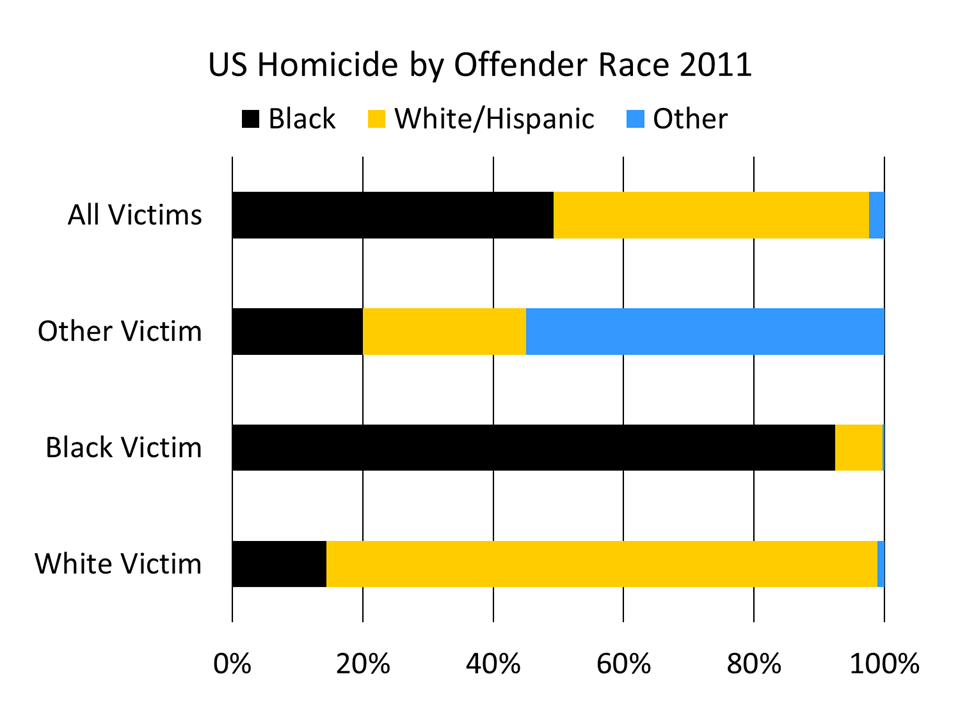
Note that the FBI classifies most Hispanics as “white”, even though most Hispanics are roughly 50% Native American.
Although blacks are only 13% of the US population, they commit roughly 50% of the murders. In most cases, the victim and the perpetrator were of the same race. 92% of black victims were killed by other blacks. 85% of white victims were killed by other whites. You can’t see the counts in this chart, but more than twice as many whites were killed by blacks than blacks were killed by whites.
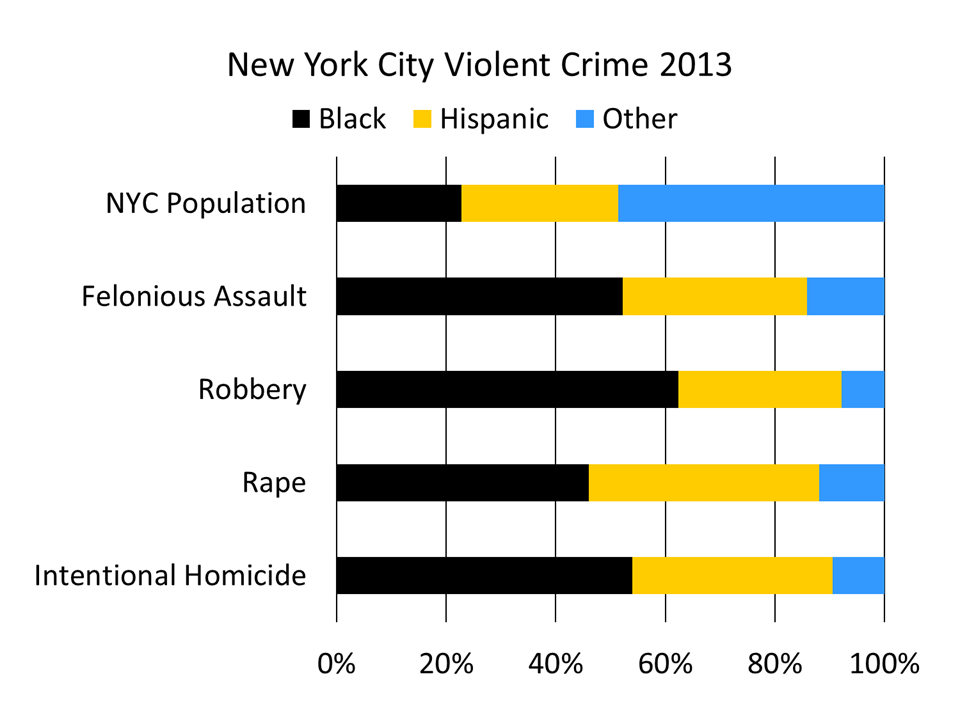
Now, let’s look at violent crime statistics for New York City, 2013. The NYPD has a “Hispanic” category that includes both “black” and “white” Hispanics. (Race is a fuzzy notion.) New York City is 33% white, 23% black, 29% Hispanic, and 15% other races. Together, blacks and Hispanics are 52% of the New York City population, but they commit a much higher percentage of the violent crimes.
Tribalism versus Civilization
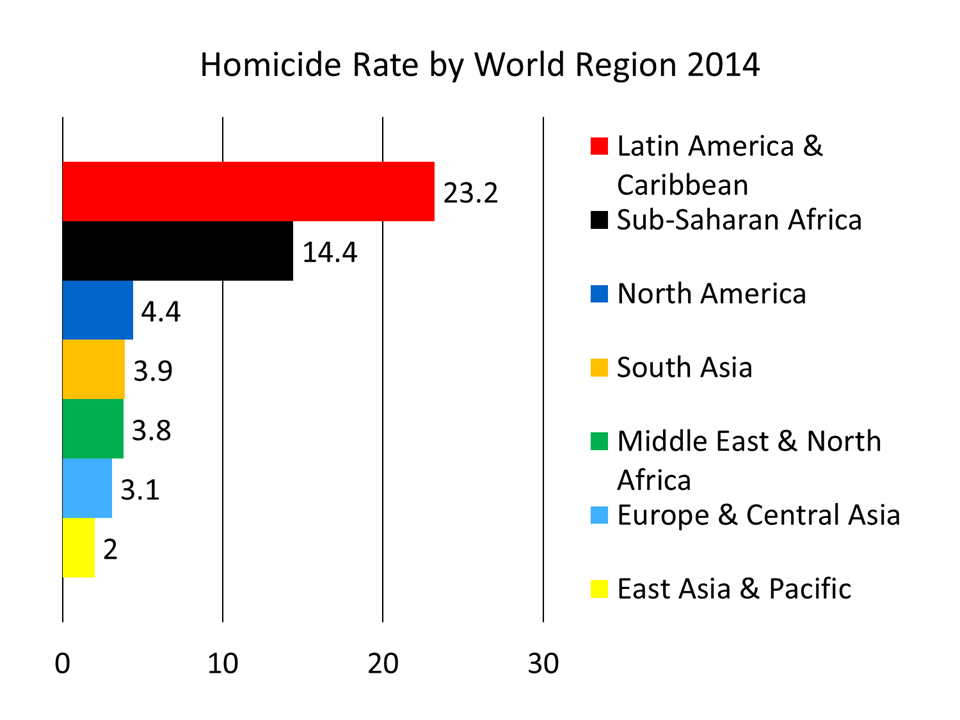
Hispanics and blacks also have the highest rates of homicide in the world as a whole. The highest rates of violent crime are found in sub-Saharan Africa, Latin America and the Caribbean. If you look at the worldwide distribution of homicide rates, a pattern emerges. Places that have a long history of civilization, such as East Asia and Europe, have low homicide rates. Places with no history of civilization or that had unstable civilizations have higher homicide rates.
I believe that this has something to do with the evolutionary history of those populations.
In civilized societies, the state has a monopoly on violence, so there is little payoff for interpersonal violence. Murder, rape, assault and theft are punished by the state. Instead of fighting each other for dominance, men compete by trying to acquire competence and wealth. Men work their way up the dominance hierarchy by cooperating with other men: by demonstrating their competence and playing by the rules.
In a tribal society, men can fight their way up the dominance hierarchy. A typical tribal society has only about a dozen adult males, so an individual man has a chance of fighting his way up to the top and reaping the reproductive rewards of being a “big man”.
Sub-Saharan Africa was mostly tribal until European conquest, but there were civilizations in the Americas with roughly the same level of social complexity as ancient Sumer or Egypt. However, those civilizations weren’t very stable. They tended to collapse back to tribalism, and they never imposed civilization on most of the Americas.
The instability of Native American civilizations was probably due to a lack of deadly diseases. Human populations are limited by some combination of war, disease and famine. When there is little disease, the population must be controlled by famine and war, and famine tends to cause war. Hungry people will fight over land to grow crops. Before European colonization, the Americas were probably the most violent place on Earth. I think that explains why the civilizations in the Americas were unstable, and maybe why Latin America has such high rates of interpersonal violence today.
Father Privilege
There is no such thing as “white privilege” in the US today, but there is “father privilege”.
67% of black children live in single-parent families, compared to 25% of white children. This has a big impact on parental investment and household income. It also has a big psychological effect. Children need fathers as well as mothers. Boys need male role models. Also, fathers are male authority figures, and father-son interaction teaches boys how to deal with male authority.
Sexual promiscuity is often associated with violent behavior. Love and marriage go together, and so do violence and promiscuity. It’s a basic biological principle. When paternity cannot be established, males will not invest energy in caring for offspring. Instead, they will compete for access to females.
Having a father is not a privilege, but it is a huge advantage in life. This advantage is not being denied to black people by white people. It is being denied to black children by their parents.
Racial Egalitarianism
The fundamental assumption of racial egalitarianism is that preferences and abilities are equally distributed in all races. If the races are equal by assumption, then any difference in outcomes must be due to some other factor, usually “systemic racism”.
Racial egalitarianism is an ad hoc assumption, and it is false. The brain is not off-limits to evolution. There is good evidence for race differences in mental traits. Even if there are equal opportunities by race, there can be unequal outcomes, because races differ in the distribution of abilities and preferences.
Racial egalitarianism is similar to feminism. They have the same structure. Both identify one group of people as victims and another group as oppressors. The victims are portrayed as lacking agency, and the oppressors are portrayed as having all the power. The notions of “systemic racism” and “white privilege” are analogous to “patriarchy theory” and “male privilege”. They are unobservable and thus unfalsifiable. Both feminism and racial egalitarianism deny biology. Both view the mere existence of stereotypes as oppressive. All criticisms of feminism are labeled “misogynist” and dismissed without debate. All criticisms of racial egalitarianism are labeled “racist” and dismissed without debate. It is considered racist to question whether systemic racism exists. Feminism and racial egalitarianism both attempt to silence their critics with soft and hard forms of censorship. Both are used to justify unequal treatment. Feminism justifies the oppression of men. Racial egalitarianism justifies the oppression of whites.
These ideologies are tearing our society apart. They create divisions and resentment. We need to fight against them.
Blacks in the United States are not oppressed. The president is a black man. My doctor is a black woman. Hard-working, intelligent black people have the same opportunities as hard-working, intelligent white people. Black people have equal rights and should have equal responsibilities within society.
The death of Michael Brown had nothing to do with the color of his skin. It was caused by the content of his character.
Sources
New York City Crime Statistics