Modernity
What is modernity?
I define modernity as the form of civilization that emerged in the 20th century in European countries. By “European” I mean culturally and biologically European, not geographically European. The United States is a European country, for example. Modernity is the cultural and social order of modern civilization, which came from European civilization.
The key feature of modernity is progress. Modernity has processes that generate progress, including science, capitalism, freedom of speech and democracy. Each of these processes involves individual freedom within a stable framework.
Science, for example, takes place within the framework of scientific institutions and the scientific method. Within that framework, individuals are free to explore new ideas. Science also has an empirical way of testing ideas, rejecting some and accepting others.
Science generates progress because it is evolutionary. It has the three components of the evolutionary process:
- Reproduction: Ideas are copied from mind to mind, and can spread from a single mind to many minds.
- Variation: New ideas are introduced occasionally, as variations on existing ideas or as more complex systems of ideas developed by individual creativity.
- Selection: Ideas are tested by logical analysis and experimentation. Some ideas fail and are discarded. Others succeed and are reproduced.
Capitalism is also an evolutionary process. It takes place within the stable framework of the market, which is created by the rule of law. It has the following components:
- Reproduction: Product types and production systems are ideas that are copied from mind to mind, and can be actualized in many different instances. For example, there are many McDonald’s restaurants selling McDonald’s burgers.
- Variation: New product types and production systems are invented occasionally, as variations on existing ones or as significantly novel ideas developed by individual creativity.
- Selection: Products and production systems are tested by the market. Some generate profits, others do not. Those that generate profits are reproduced.
The technological progress of modernity is driven by the twin engines of science and capitalism.
Freedom of speech and democracy also have the potential to generate cultural and social progress, but not as effectively. Freedom of speech allows ideas to compete in a “marketplace of ideas”. The selection process, however, is simply whether the idea is persuasive. Democracy allows for a non-violent struggle for political power, but again, the selection process is based on persuasion, not empirical testing. Public discourse and democracy are susceptible to a “tragedy of the commons” problem. Ideas that are collectively harmful can be selected by individuals. However, in spite of those flaws, democracy and freedom of speech can generate progress.
See Game Theory and Cooperation, Social Delusions and Democracy is a Tragedy of the Commons.
There is another key component to modernity: abundant energy. Modernity depends on a huge input of energy, mostly from fossil fuels. Humanity has gone through a series of steps in which its energy consumption increased: hunting large animals, agriculture, pastoralism, the use of draft animals, the use of wind power, and fossil fuels.
The age of exploration could have been called “the age of wind power”. Europeans invented new sailing technologies that harnessed the wind more effectively. Sailors learned how to use prevailing winds to travel between continents. Wind power was also used to drain swamps and grind grain in Europe. Trade increased, new lands were discovered, and economic production increased. This set the stage for the industrial revolution.
The industrial revolution inherited the idea of complex machinery from the wind revolution. It added a new source of energy: coal. Energy pulled out of the ground could be used to do work. Industrialization, which was already in progress, expanded rapidly by a virtuous cycle. Complex technology allowed for greater energy extraction and consumption, which in turn enabled a greater use of complex technology. The result was an acceleration of technological and economic progress. That progress was generated by science and capitalism, but it was powered by fossil fuels.
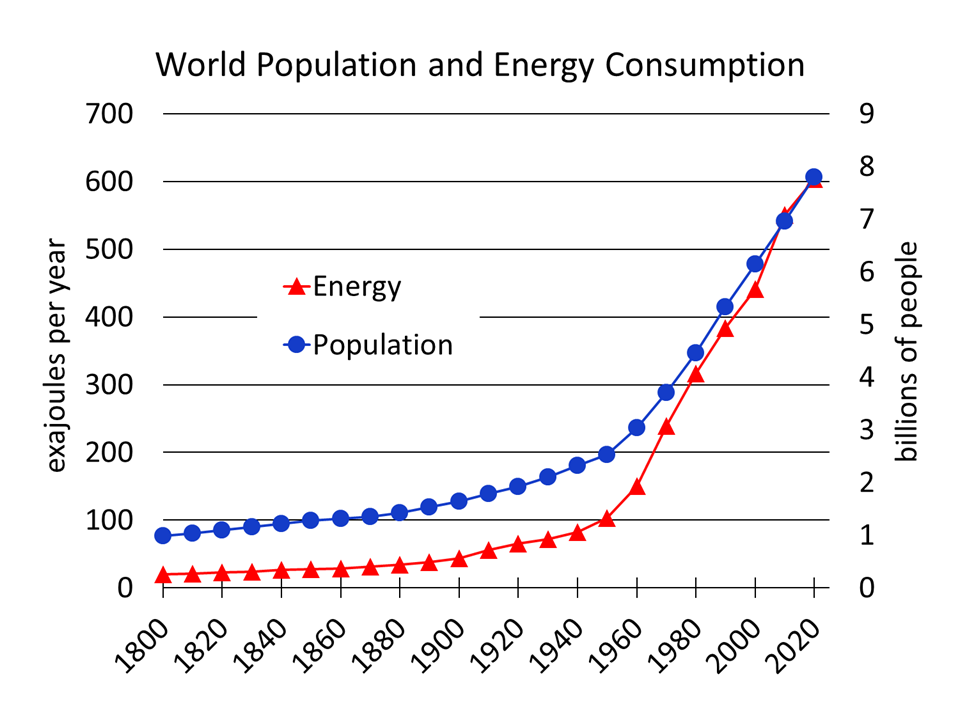
For the last 500 years, Europeans were able to expand their population and economy by a virtuous cycle. Progress wasn’t always fast enough to prevent hunger, as the Irish potato famine shows, but it often was. The opening up of new lands for colonization and trade also helped European civilization to outpace hunger. Knowledge, capital and energy consumption increased faster than the population expanded. That created modernity.
Modernity is characterized by abundance, due to economic progress outpacing population growth. Prior to modernity, most people were peasants living close to starvation, and most children died young. Modern civilization is a dramatic departure from historical norms.
The main features of modernity are the following:
- Abundance: People have abundant food, energy and luxury items.
- Ease: Most hard manual labor has been replaced by machine labor. Most people have jobs that require little physical strength or hardship.
- Urbanization: Most people moved from small farming communities to much bigger cities or suburbs.
- Low violence: There are low levels of interpersonal violence, and a high level of enforcement of non-violence by the state. Modern warfare, although potentially horrific, tends to be limited and causes fewer deaths than it did in the past.
- Low child mortality: Most children live to adulthood.
- Low fertility: People have few children. Most women work outside the home.
- Long life: Because of modern medicine and improved living standards, most people live well into their 70s or beyond.
- Leisure: Because the natural problems of life are much easier to solve, people have more time to spend on other activities, such as entertainment, hobbies, etc.
Modern civilization gives almost every child the opportunity to live a long, healthy life. Given the choice, almost everyone would prefer a modern lifestyle over a premodern lifestyle.
The amazing progress of the past 500 years, culminating in modern civilization, has made many people extremely optimistic about the future. They have come to expect progress, as if it were inevitable. They believe that we have left behind the problems of the past forever.
However, there are serious problems with modernity:
- Finite resources: Modernity temporarily solved the problem of scarcity by expanding total production, especially food production. This isn’t a long-term solution to scarcity. Economic growth can’t go on forever. Population growth will eventually catch up, and bring back scarcity. The lower fertility that typically results from modernity will not prevent this. See Fertility and Destiny.
- Dysgenics: Modern civilization is biologically regressive, not progressive. The relaxation of selection in modern civilization is degrading the genome. Either we regulate our genome with eugenics, or it will degrade until it can no longer support modern civilization.
- Alienation: I use this as a blanket term for problems caused by the mismatch between the human brain and the modern environment. Although the modern environment is desirable, our brains are not adapted to it. In modern civilization, human behavior becomes maladaptive.
If we don’t solve these problems, modern civilization will eventually collapse. Most of the essays in this book deal with the problems of modernity.
I should briefly mention the concept of post-modernity. To me, post-modernity is really late modernity: the social and cultural conditions of the West after the culmination of modernity. Post-modernity is not a stage after modernity. It is the condition that exists after modernity has created abundance. I discuss the transition from early to late modernity (or modernity to post-modernity) in The Sixties.
I believe that we are living in the final stage of modernity. Solving the problems of modernity would require another revolution, which would create a new form of civilization. That would be the beginning of a new age. If we do not solve the problems of modernity, then modern civilization will collapse, and we will return to the premodern condition.