Representation and Reality
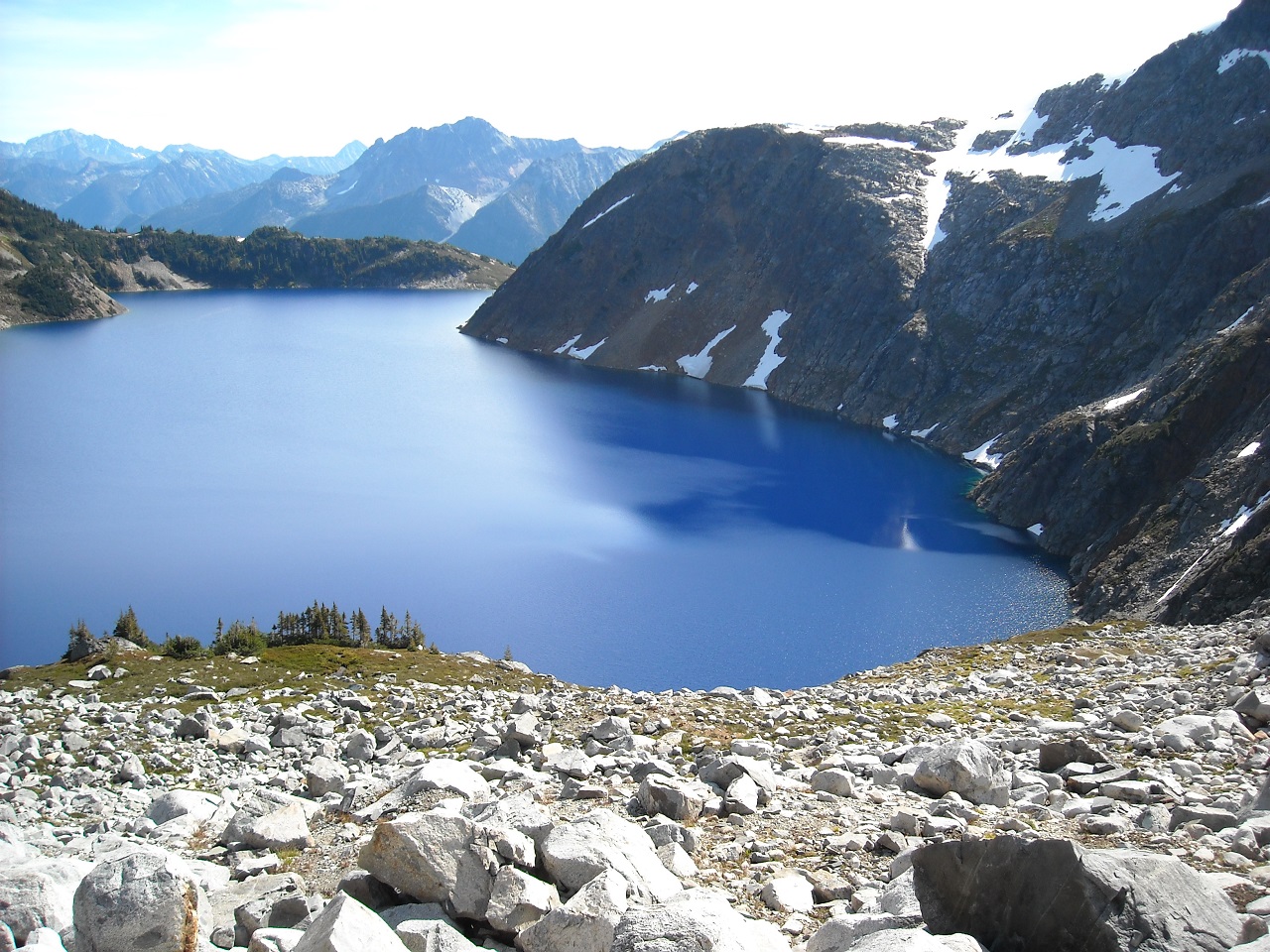
It is a warm, sunny day in mid-September. I am crossing a field of boulders, high in the mountains. To my left, far above, a jagged ridge is silhouetted against the blue sky. To my right, far below, a deep blue alpine lake sparkles in the sunlight. The slope between them is a mosaic of boulder fields and cliffs, with a few patches of krummholz and heather clinging to the rocks. Sweat is trickling down my forehead and into the corners of my eyes, making them sting. I lick my lips, tasting salt and rock dust.
At a conveniently shaped boulder, I stop to rest. I take off my backpack and put it down on a rock. I sit on the boulder and relax. The air feels cool on my sweaty back and shoulders. I gulp water from my bottle, and wipe the sweat from my face with my sleeve. I gaze at the landscape, allowing it to fill my awareness. The ridge across the lake is almost bare of vegetation: just gray rock and white snowfields. To the east, I see range after range of mountains, fading away into the distance. The lake below is a deep royal blue, with sunlight sparkling on the surface.
Suddenly, I hear the sharp crack of a rock hitting another rock, somewhere behind me. I spin around, looking for the source of the noise. When I see it, I relax. The rock isn’t heading toward me. It bounds down the slope in huge leaps, raising little puffs of dust where it hits other rocks. It goes over a cliff below, and I lose sight of it, but I can still hear it clattering down the slope, until it stops somewhere far below.
Rocks have been falling from the ridge all morning, making me uneasy.
I think about the event that I have just experienced. First, there was a sound. I knew that it was caused by a falling rock. Then, I looked for the rock. I only caught glimpses of it, as it tumbled down the slope. Yet, my brain integrated all of those different experiences into a single idea: the idea of a rock falling down the slope.
I have a sudden revelation.
Ideas are the connections between experiences.
I pick up a rock and hold it in my hand. It feels dry, dusty and rough.
I know the rock through an idea.
The rock is out there in reality. My perception of it is an idea in my brain. The rock affects my senses in various ways. The idea of the rock explains the sensation in my hands and the images on my retina as the effects of an object with predictable properties. The idea links those different sensory experiences together. The visual image explains and predicts the feeling in my hands, and vice versa.
I turn the rock over and over in my hand.
I act on the rock through an idea.
As I turn the rock in my hand, information and causality are flowing between my brain and the rock. Perception is information flowing into the brain and being interpreted. Action is information flowing out of the brain and affecting external reality.
The idea of turning the rock causes my muscles to contract and relax in certain ways, which causes the rock to turn over in my hand. This changes the images on my retinas and the feeling in my hand. My perception of the rock changes as I turn it. Information is flowing back and forth between the rock and my brain, through my senses and muscles.
The idea of the rock relates different types of sensory input: vision and touch. It also relates sensory input to motor output. It predicts sensory input based on motor output, and it generates motor output based on sensory input.
Action depends on perception. Perception depends on action.
I know the world through ideas. I act into the world through ideas.
I put the rock down on the boulder beside me. I look away at the distant mountains.
The idea of the rock also explains the relation of sensory experiences across time. I know that the rock is still there. I know that I will see it if I turn my head in that direction.
I look at the rock. In doing so, I turn my head exactly the right amount to focus on it, without any mental effort. I knew where it was, not in terms of inches, but in terms of action and perception. I see the same image as before: the rock, rough and slightly dusty, sitting on the boulder.
I reach out to pick up the rock. I extend my hand exactly the right amount, spreading my fingers apart exactly the right amount, and then grasp the rock, exerting exactly the right amount of pressure on it so that it does not slip through my fingers. I pick it up, flexing my muscles in exactly the right way to position the rock in front of me. As I do this, I slightly shift my body to maintain my center of gravity. I would not be aware of this normally, but I am now.
The rock feels dry and dusty, as it did before. I toss it down the slope. It clatters across the boulders, falls into a crevice and disappears.
I pick up another rock and hold it in my hand.
What makes this a rock? Why do I use the same concept to represent this thing, that thing I just threw, and the thing I saw bouncing down the slope a few minutes ago?
Similarity of form.
Seeing one rock is similar to seeing another. Picking up one rock is similar to picking up another. Throwing one rock is similar to throwing another. “Rock” is a pattern that I have learned from experience.
I let go of the rock. It falls into a crack between the boulders. I drink some more water. I gaze at the lake far below.
Eventually, I get up, put on my backpack, and continue working my way across the boulder field.