Response to Arctotherium

I recently put out a post on fertility collapse, The Paradox of Low Fertility, in which I claimed that the fertility collapse is mostly due to modern birth control. Some people disagreed with this explanation. For example, one person said:
Your theses regarding the pill is a bit outdated. I would recommend arcotherium’s piece overviewing the four phases of demographic transition (in the West). A quick rebuttal is to point to France’s history.
— Peter Rabbit
I responded:
Yeah, I’ve read it. He underestimates the importance of birth control. I don’t think I mentioned the pill in the essay. Birth control is a more general notion, which includes many things, including the pill, condoms, abortion, the rhythm method, etc. For example, after WWII, the Japanese relied heavily on abortion to limit fertility. The point I’m making is that people have an increased ability to limit reproduction. Women also have an increased ability to delay marriage. There are multiple factors involved (which I described) but birth control is very important. There was a big collapse in fertility after the birth control pill was introduced in the West.
I am going to expand on what I said there, and respond to some of the points in Arctotherium’s essay, which mostly ignores birth control as a cause of low fertility.
His essay begins with the paragraph:
Human net fertility is complicated. Some things that matter on the margin: winning elections, baby simulators in health class, war, housing costs, religion (both type and intensity), women’s education, population density, racial diversity, STD-induced infertility, baby bonuses, antinatal propaganda campaigns and sterilizations, and status-messaging in soap operas. The full list is much longer. But most of these factors are just not that important—a few percent here, a few percent there, and with sharply diminishing returns.
Birth control is conspicuously absent, as if the birth control pill, latex condoms, IUDs and safe abortions had no effect on fertility whatsoever. You could argue that birth control is not the primary cause of low fertility, but to completely ignore it seems a bit strange.
Some people might say “Birth control has existed for a long time, and thus it couldn’t be the cause of this recent change”.
Of course, birth control is not entirely new. Some methods of birth control have existed for a very long time. Abstinence is the simplest, but it requires overriding sexual impulses. The rhythm method (periodic abstinence during times of ovulation) is a bit more sophisticated. It requires some education, and is made more effective by having an accurate thermometer. Withdrawal is another old method, but it requires overriding the sexual impulse near the moment of orgasm, and it doesn’t always work. Condoms made from animal intestines were used in the past. There were also primitive, dangerous methods of abortion.
Modern birth control methods are much more effective, because they are convenient, reliable and safe. The latex condom and the birth control pill are very effective at preventing pregnancy, don’t reduce the pleasure of sex very much, and require little impulse control. So, they are much more effective than old methods. Modern abortion is also much safer, and is readily available in most Western societies.
Modern birth control gives the individual much greater control over reproduction. It is an expansion of human agency. It makes reproduction into a choice, rather than a likely consequence of having sex. And there is no guarantee, built into human nature, that people will choose to reproduce, given that choice.
Before getting into the evidence and arguments, it’s worth taking a moment to consider the moral/political reasons why some people might prefer the cultural-values explanation over the birth-control explanation.
The cultural-values explanation is popular with conservatives and reactionaries, because it allows them to blame the left for the problem. And it’s true that the left has been waging cultural warfare against family values for decades: promoting sexual liberation, encouraging women to become financially independent, denigrating motherhood and the nuclear family, cock-blocking men, and so on.
There is also a deep aversion to biological and psychological realism about human nature. Most people have an essentially magical view of human nature. They don’t think about human beings as machines that can malfunction.
For many people, I think that is the sticking point. It is a heresy to suggest that expanding human agency can lead to maladaptive behavior. It implies that human beings need external constraints. It implies that you don’t necessarily know what is good for you — that your desires could be systematically wrong, not because you have been deceived, but because you have been given new freedoms.
Now, let’s dive into the evidence and arguments. I’ll start with a chart that Arctotherium used in his essay, showing the TFR over time of the Netherlands. Unfortunately, I don’t know the source of this chart, but it seems right to me, so I will assume that it is correct. It should be representative of the general changes in Western fertility.
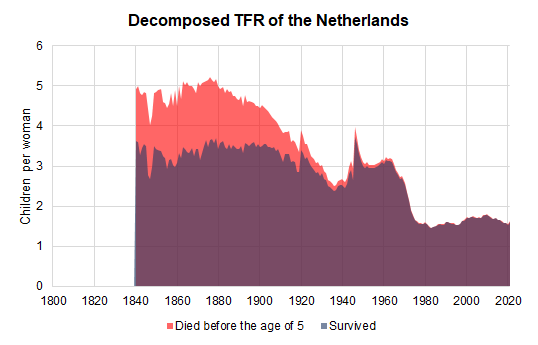
This chart shows the “demographic transition” very clearly. During the 1800s, fertility was roughly 5 children per woman, but only 3.5 of those children survived infancy on average. Although women are capable of having 10 or more children, 5 is a rough estimate of the natural fertility rate for a women who survives to menopause. In the past, most people died young. In a balanced state, excess reproduction is balanced by premature death.
As more children survived past infancy, the fertility rate declined, probably due to two factors: prolonged nursing and economic considerations. To some extent, existing children displace potential children. Some methods of birth control were available in the 1800s. There was also an increase in education, women working outside the home, urbanization, etc. However, the average number of children surviving infancy remained at roughly 3. During this time, the population grew, due to the advances of modern civilization (hygiene, medicine, more food, etc.), which allowed a greater percentage of people to survive from birth to adulthood.
Fertility dipped during WWI, and then rose slightly, before falling again. What caused the dip in the 1920s? One likely explanation is the latex condom, which became widely available after its invention in 1920. Arctotherium does not explain the rapid decline after 1920. He seems to view it as part of the longer trend of declining fertility, due to family planning (in other words, birth control). But he does not mention that a new method of birth control became available at that time.
Note that fertility rebounded somewhat during the 1930s, despite (or perhaps because of) the Great Depression. It increased even more during the 1940s in most Western countries, culminating in the “baby boom” from 1945 to 1960.
Arctotherium explains the baby boom as due to a relative increase in the male-to-female income ratio. I think he’s probably right. When women have a greater economic incentive to marry, they tend to marry younger and have more children. The 1920s were a brief prelude of the sexual imbalance that came later in the 20th century. The Great Depression and WWII restored the balance between the sexes for a few decades.
After the baby boom, there was a huge collapse of fertility in the 1960s and early 1970s. Arctotherium explains this as due to feminism and sexual liberation. However, he omits a very important factor: the birth control pill, which was introduced in 1960 in the US, and around the same time in many other countries. The precipitous collapse of fertility in the 1960s followed immediately after its introduction. See the chart at the beginning of the essay.
But not every country introduced the birth control pill in 1960. In Ireland, it wasn’t introduced until 1981. Prior to that, artificial forms of contraception were illegal. The Franco regime in Spain also criminalized artificial contraception. In Spain, contraception was decriminalized in 1978.
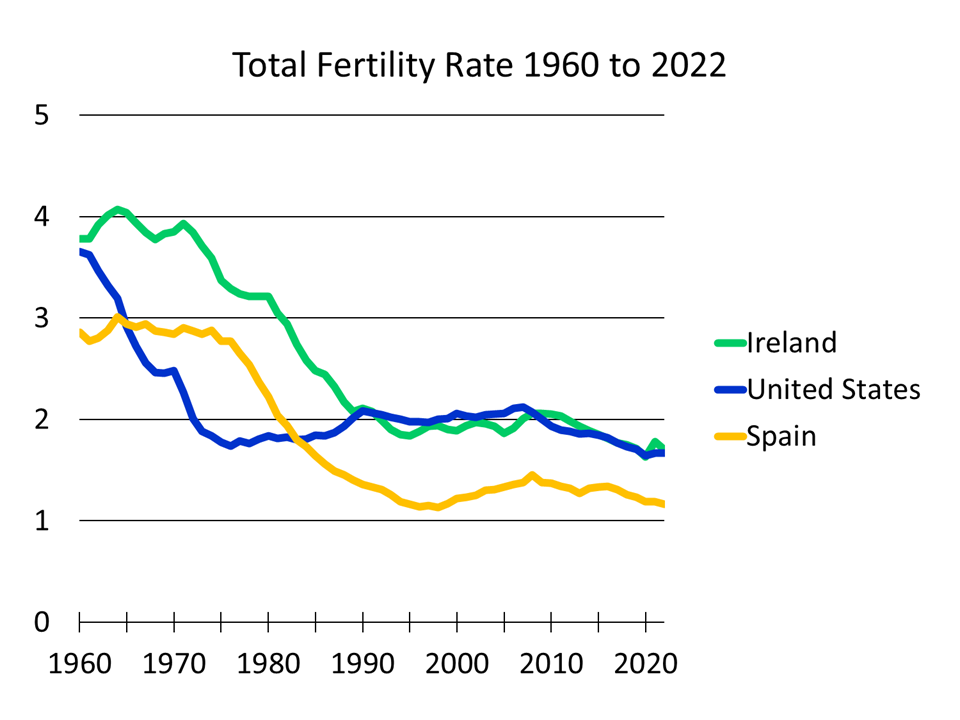
Despite Ireland being very similar to other Western societies in its culture and way of life, the fertility collapse was delayed by roughly 20 years. During the 1960s and 1970s, the Irish were exposed to roughly the same cultural influences (rock music, drugs, TV, etc.). Nevertheless, Ireland maintained much higher fertility until contraception was legalized.
Similarly, the fertility collapse in Spain occurred after the legalization of contraception. Arctotherium explains this as follows:
Spain provides a test case of my assertion. By putting the boot on Communist-adjacent New Left feminists, Franco froze in place Western norms around sexuality and marriage for a decade longer than they persisted in the core West. As expected, the post-(partial)-Baby-Boom collapse was delayed a decade in Spain.
As usual, he ignores contraception.
Let’s look at a non-Western country: Iran.
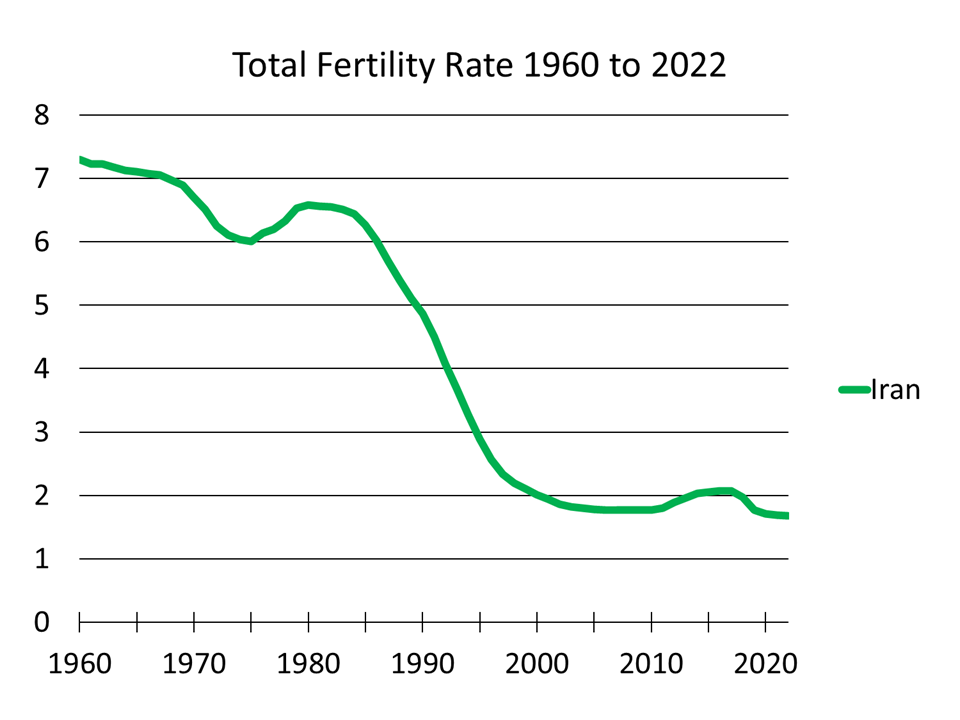
In 1989, Iran’s government reversed earlier pronatalist policies, making contraceptives widely available. Fertility had been slightly declining before, probably partly due to increased economic hardship and the death toll from the war with Iraq. After 1989, there was a deliberate effort to reduce fertility, and it worked.
Clearly, feminism is not necessary for a fertility collapse. Iran is hardly feminist by any stretch of the imagination, and yet it has below-replacement fertility.
Arctotherium does mention contraception briefly, late in his essay, only to dismiss it. Here is what he says:
Astute readers may notice that I don’t mention the Pill or legalized abortion. This might seem strange; isn’t cheap, effective, and convenient contraception the obvious explanation for the Second Demographic Transition? Why bother appealing to difficult-to-quantify cultural and legal changes when there’s such a clear technological answer?
The reason is simple: family planning is not a difficult problem. Even with the most common premodern solutions of abortion and infanticide taken off the table by Christianity, Western countries were able to reduce fertility to well below replacement in the interwar period with the same sorts of techniques that have been available since people first figured out where babies come from. Even if these techniques are unreliable and inconvenient on an individual level, they are more than sufficient on the population level.
This is nonsense. Family planning is a difficult problem, because people like to have sex. There was a reduction in fertility in the interwar period (or more precisely, after 1920), which was immediately after the introduction of a new birth control method, the latex condom.
Obviously, by making something easier to do, you make it more likely to be done, if people want to do it. For example, it shouldn’t be surprising if making it easier to commit theft increases the rate of theft. It should not be surprising that making it easier to prevent pregnancy was followed by a decrease in the fertility rate.
Although his essay focuses on the West, Arctotherium points to Japan as an example of how low fertility can be attained without the birth control pill. Japan had a fertility collapse immediately after WWII. Of course, Japan is very different from Western societies, both culturally and in its situation after the war. Many young men died in the war. There was a loss of status. There were also major concerns about overpopulation. Japan was on the brink of starvation after WWII. The Japanese did not have the birth control pill, but they did have the latex condom and relatively easy access to abortion. They had a cultural tradition of using infanticide to limit family size, so they were less averse to abortion. Also, the Japanese have generally high impulse control, so they are more able to use abstinence-based methods.
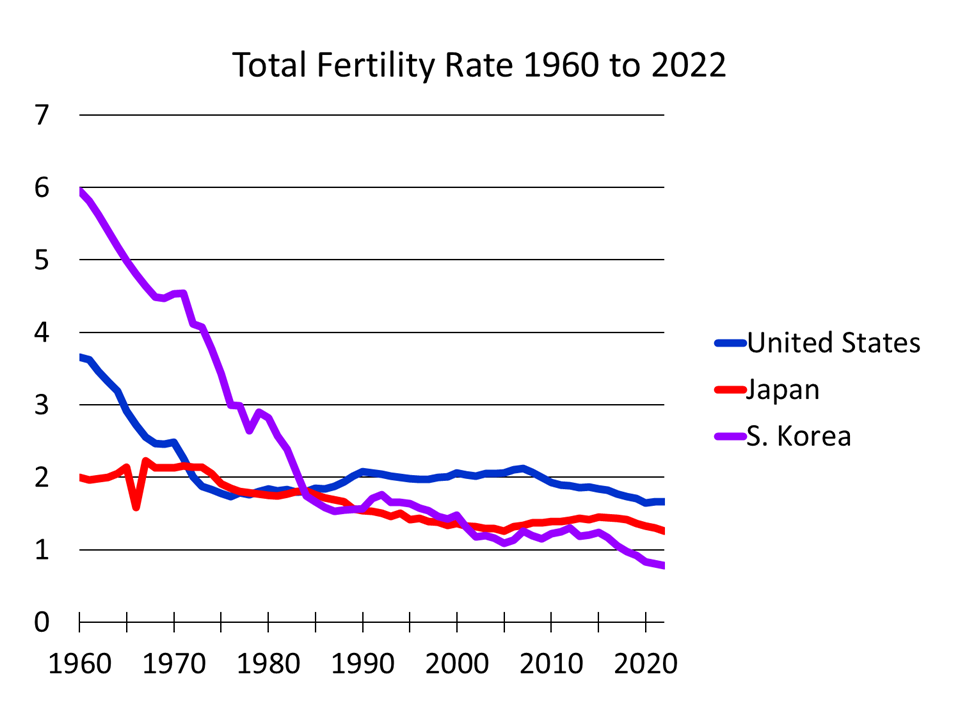
South Korea had a profound decline in fertility since 1960, which accelerated in the 1970s, when the birth control pill became easily available.
Again, I feel the need to point out that “birth control” and “the birth control pill” are not synonymous. Modern birth control includes many different technologies.
Arctotherium explains the recent decline in Western fertility since 2010 as due to new technology, such as smartphones and the internet. That is the obvious explanation, but the causal pathway is not so obvious. He proposes that young people are simply doing other things online, rather than forming relationships or having sex. That’s possible, but it seems a bit dubious. Vidya and pron aren’t great substitutes for sex and love. There are other possible explanations.
I don’t believe that the recent decline was entirely due to contraception, but I will point out that the “Plan B” contraceptive, also known as “the morning-after pill”, became widely available during 2000–2013.
Birth control can’t explain all the changes in fertility in recent history. For example, it doesn’t explain the baby boom. But it does explain a lot.
The sexual revolution did not have a single cause. Birth control was part of a package of technological, social and cultural changes, each of which enabled the others. Modern industrial society liberated women from their dependence on husbands for comfort and security, which enabled women to delay marriage or forgo it entirely. Birth control also enabled women to delay marriage and pursue careers. A low fertility lifestyle became culturally normalized, which made it easier to adopt. It was a slippery slope, with multiple interacting factors.
Leftism had something to do with it, but I believe that leftism is as much an effect as a cause of the sexual revolution. Feminism is more of a post hoc rationalization of sexual liberation than a prior cause.
Ultimately, the fertility collapse is the result of biological mismatch. Human nature is adapted to the ancestral environment, not the modern environment. In this new environment, people make maladaptive choices.
At the end of his essay, Arctotherium points out that people did not predict the fertility collapse. That is true. They didn’t predict it because they didn’t have a correct theory of human nature. To solve modern problems, we need to understand ourselves.