The Establishment
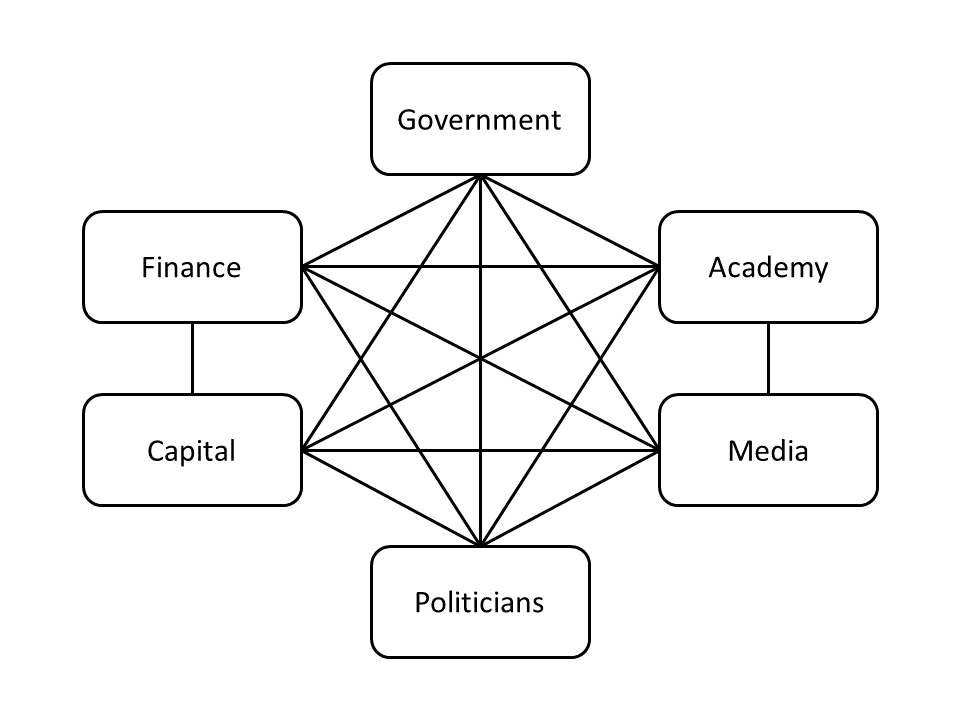
A society is not just a collection of individuals. It is an organized group of individuals. A society has a power structure, which holds it together and allows it act as a unit. That power structure gives the society coherence and agency.
Regardless of the nominal political system (democratic or otherwise), the social power structure will always be hierarchical, because a hierarchy is the only effective way to organize a large system. The establishment is the upper level of the social hierarchy.
The establishment itself is a power structure. In the modern West, the establishment is complex, and few people view it as a unit. We are taught to view the components of the establishment as independent parts of society. In this essay, I will describe the establishment in terms of its component parts and how they are related.
In the modern West, the establishment has the following components:
- The government
- The financial system
- The owners of big capital
- Politicians and political parties
- The entertainment and news media
- The academy
Each of these components is a node in a power structure. Each is linked to the others. Each has an important social function.
The establishment is not a secret cabal or a conspiracy. It is too big for that. It is an emergent power structure. There may be (and probably are) various conspiracies within the establishment, but the establishment itself is not a conspiracy.
Also, the establishment is not necessarily harmful. Society needs a power structure. The establishment has an important social function. It gives society coherence and agency. However, it can be corrupt or dysfunctional.
Although I am going to present a view of the establishment in a single country, the modern Western establishment is increasingly an international structure, because several of the nodes are international to some degree (finance, capital, media, academy). But for simplicity, I will focus on the structure within a single country.
The different components of the establishment work together and reinforce each other. This is not due to a conscious design or plan. It is emergent. If the components did not reinforce each other, the structure would be unstable. It would eventually collapse and be replaced by something else. A stable, self-perpetuating power structure tends to emerge in any society.
See Adaptive Coherence.
To put it simply, social power is the ability to control people. Ultimately, social power comes from individuals, and their ability to work. A society is based on controlling individual actions. Society is a power structure, in which certain individuals and/or institutions control the actions of many people. In principle, individuals are controlled for the collective good, to solve problems of cooperation.
See Game Theory and Cooperation.
The concentration of power makes society possible. However, it also creates the potential for corruption. People, as individuals or groups, try to rig the social power structure in their favor. I will call individual members of the establishment “elites”. Generally speaking, the establishment is rigged in favor of elite interests. It also reflects the beliefs and values of elites.
In a modern society, there are different types of social power. For example, the police wield a type of social power: they can use violence and coercion to impose the law on individuals. Money is another type of social power. A person or institution can use money to purchase the labor of others. There are three basic types of social power: punishment, reward and persuasion. They are different ways of controlling human behavior. The justice system has the power to punish people. Big corporations have the power to reward people with money and jobs. The media has the power to persuade people with news and entertainment. One type of power can often be exchanged for another. For example, money can be used to bribe the police, hire a hitman, or get publicity.
The three basic types of social power can be further subdivided into social functions. The police and the military both have the power of punishment, but have different social functions. The media and the academy both have the power of persuasion, but have different social functions.
In the modern West, social power is distributed among the nodes of the establishment. Each node has different types of power and different social functions:
- Government: money, jobs, police, military
- Capital: money, jobs
- Finance: money creation, interest rates
- Media: control of mass culture, authority on specific knowledge
- Academy: control of elite culture, authority on general knowledge
- Politicians: brokering deals, appealing to the masses, elected positions
Each node wields its power partly to carry out its social function, but also to perpetuate itself within the establishment, to support the establishment as a whole, and to benefit elites within the establishment.
✦ ✦ ✦
In theory, each node of the establishment is controlled by the will of the people, either through a democratic process or through the market. The masses choose how to vote. The financial system is regulated by the government. Individuals choose how to spend their money in the market. They choose what entertainment and news to consume. They can choose to get higher education or not, and what education to get. There is a “marketplace of ideas” (culture) in which different ideas compete and individuals can select the best ideas.
So, in theory, power is ultimately in the hands of the people. However, there are some problems with this theory. In reality, power is concentrated in the establishment. The democratic process, the market, and even the culture are largely controlled by the establishment.
First, let’s debunk the idea that democracy gives the people control over the government.
Political parties and candidates require funding, which they get from big capital. Politicians and political parties depend on the media to promote them to the masses. The academy plays a role in shaping the political views of the masses. The government defines the electoral process and carries out elections. The government can also directly censor certain political views. Government agencies can selectively target politicians and political parties for law enforcement, such as tax audits, corruption probes, etc. The financial system can also intervene in politics, by manipulating interest rates at key moments.
Democracy is highly controlled by the establishment.
The masses lack the knowledge and incentives that are necessary to make good political decisions. A single vote has almost no effect on the outcome of an election. So, the individual has little incentive to vote wisely, or in his own interests. He also has no incentive to acquire the knowledge that is necessary to make good social decisions.
Democracy is a very blunt instrument for collective decision-making, because it simply aggregates the votes of individuals into a single decision, thereby making each vote insignificant and unrelated to the outcome that the individual receives. So, political beliefs are selected for personal reasons: to get approval from others, to compete for attention and status, and to signal identity.
See Democracy is a Tragedy of the Commons.
In the modern West, the major political parties are not that different in their rhetoric, and even less different in their actions if elected. In the United States, the Republican and Democratic parties are essentially a political cartel, often referred to as “the uniparty”.
Now, we need to debunk the notion of the “free market”.
The government creates the market by enforcing property and contract laws. This allows strangers to cooperate without fear of defection. But it also allows the government to rig the market in various ways, to favor certain interests over others. The economy is not organized through an ideal open market. A small number of conglomerates own huge sectors of the economy. Large corporations are linked together in various ways: board members, political connections, big investors. The financial system is a cartel, and people cannot choose a currency. The media affects the choices of consumers.
The big owners of capital do not acquire their wealth in an ideal open market, and their wealth is not a pure reflection of their contribution to society. Their wealth is largely acquired in other ways, such as getting favorable government contracts, getting favorable legal treatment, or borrowing vast amounts of money and using it to buy/create assets during a time of low interest rates. These days, access to funding is often more important to the success of a company than the quality of its products.
Despite its flaws, the market is still more democratic than democracy. In the market, individuals get what they choose and pay for what they choose, so they have an incentive to choose wisely. There is some competition for consumers, so corporations have an incentive to produce what people want.
The notion of the “free press” is another myth that must be debunked.
In theory, the media are independent of the establishment, and even act as critics of the establishment. This is naive. In reality, the media are part of the establishment. Media corporations are corporations, owned by wealthy elites, so their products reflect the interests and views of those elites to some extent. Also, the people who create media content — journalists, script-writers, marketers — have all been credentialed by the academy, and have a common elite culture, although most don’t make much money. Media content reflects that elite culture.
The “marketplace of ideas” is another myth. Culture is highly constrained, from the top down and from the bottom up.
Individuals are not independent thinkers who rationally consider the various ideas available and choose those which pass the tests of reason. People are limited and interdependent thinkers. They think inside shared boxes. The ordinary person is a conformist. He lacks the ability and the desire to think for himself. His worldview is mostly determined by those around him, but also by those he wants to associate with or emulate.
The conformity of the masses can be used to control them, by presenting them with artificial information. People do not just conform to the people that they interact with in real life. They also conform to the people that they see on screens. So, the media has a huge influence on public opinion, through news, entertainment and advertising. Education also plays a role in shaping the worldview of the masses.
Also, conformity creates the potential for social delusions. A belief can be socially circular: everyone believes it just because everyone else believes it. There are also memetic parasites, such as ideologies, which motivate people to signal them to others, thus spreading the meme. Modern communication technology has made it easier for social delusions and memetic parasites to propagate. Social delusions can arise from the masses or within the establishment, but establishment delusions have the support of the media, academy and government.
See Social Delusions.
The people do not control the establishment through democracy or the market. The media and the academy do not function as independent sources of knowledge. Democracy, the market, the media and the academy are all controlled by the establishment.
✦ ✦ ✦
Now, let’s consider each component in more detail, and how they support each other.
In a modern society, the state is large and complex. It consists of many different agencies that wield different types of power. Government agencies control an enormous amount of spending power. Some, such as the military and various law enforcement agencies, wield coercive power. This power can be used selectively to reward or punish.
In theory, the law is applied to everyone, without bias. This principle is called “the rule of law”. It means that the law is above all men; no man is above the law. This principle comes from a religious worldview, in which God (an imaginary man) is the ultimate authority and law-giver. However, in reality the law is defined and enforced by men. Politicians write laws, which are then enforced by police, prosecutors, judges, etc.
The law can be applied selectively, to reward friends and punish enemies. A political enemy of the establishment might find himself under much greater legal scrutiny than a friend of the establishment. His taxes might be aggressively audited, for example. He might be prosecuted for a trivial offense, while much bigger crimes by others are ignored. Protection from crime can also be withheld as a punishment for dissent. Anarcho-tyranny is the practice of enforcing the law against your enemies, but not your friends. This allows your friends to terrorize your enemies. In the West today, we are seeing an increasing use of this tactic.
The government supports the other nodes of the establishment by giving them legitimacy, directly and indirectly. The government regulates industries and provides government contracts, so it is linked to big capital. It regulates the financial system through regulations and through the central bank, which controls interest rates and the creation of money. It defines the standards for academic institutions, and partially funds them in various ways. It controls the radio wave spectrum for broadcasting. It provides the news media with much of their content. And of course, the top level of the government consists of elected politicians. So, the government is obviously highly connected to the other nodes of the establishment.
Big capital consists of large corporations and rich people who control large assets. Big capital has the power to reward individuals with money. A million dollars is a lot of money for an individual, but a tiny amount for a large corporation. Thus, big capital can control individuals with financial incentives, such as jobs, campaign contributions, or money funneled through charities. Politicians are the main targets of this control, but others can also be bribed. Senior bureaucrats can be promised jobs or positions on corporate boards. Academics can be offered funding. The media consists of corporations, so big capital controls journalism and entertainment.
Thus, although the government imposes the law on the rich, the rich can influence the politicians who make the laws and the bureaucrats who enforce the laws. Each controls the other. Power is both hierarchical and circular.
The financial system supports the owners of big capital by keeping interest rates low. This is important, because most big corporations depend heavily on debt. It also inflates asset prices, such as real estate and stocks, making the rich richer. The financial system supports the government by allowing it to borrow unlimited funds, and by keeping the interest rate low. The financial system is also highly regulated by the government. Each depends on the other. So, the financial system is strongly linked to the government and big capital.
It is also connected to the other nodes. It employs academics, and it relies on economists to justify its actions. The central bank also relies on the media to communicate and justify its actions to the public. The upper management of the central bank is directly connected to the highest level of government.
Together, the media and the academy are the “Ministry of Truth”. They have implicit authority over truth claims. They also shape collective values through propaganda. The academy has an effective monopoly on the production and distribution of abstract knowledge, which includes moral and political indoctrination. The media has a monopoly on the production and distribution of news, entertainment and advertising, all of which include moral and political indoctrination. The academy and the media control the minds of the masses.
The media and the academy are not monoliths. Each consists of many quasi-independent organizations. The academy consists of many educational institutions. The media consists of many different companies. However, both have unifying structures, standards and cultures. In practice, both the academy and the media operate like cartels.
The government plays a big role in regulating and funding the academy. In the US, a federal agency controls the accreditation of post-secondary institutions. The government defines what a post-secondary education is, and roughly how colleges must operate. The government is also the largest source of funding for academic research. The government issues student visas, and allows academics to immigrate relatively easily. Finally, the government guarantees student loans, providing a huge financial subsidy to educational institutions.
The academy is also linked to big capital. Educational institutions receive donations from corporations and rich individuals. Big corporations hire people with academic credentials, thus making them valuable. Big corporations also directly fund some academic research.
A post-secondary education is almost a requirement to be a member of the establishment. Most elites have at least a Bachelor’s degree, whether they are government bureaucrats, journalists, businessmen, economists, politicians or professors. This gives them a shared culture, and sets them apart from the less educated masses. It also creates a demand for post-secondary degrees, which supports the academy. Not everyone with a post-secondary education is part of the establishment, but almost everyone in the establishment has gone through the academy.
The media approximates a cartel in many ways, justifying the usage of “media” as a singular noun. It is also highly linked to the other nodes of the establishment. “Independent media” is a myth.
A small number of large corporations dominate the production and distribution of news, entertainment and advertising. Those corporations and their owners are part of big capital. The media also receives much of its income from advertising. So, it is linked to big capital.
The media is also linked to the government and politicians. It is highly regulated by the government, and it depends on government sources, both bureaucrats and politicians, for much of its content.
Many countries have state-funded media corporations, such as the CBC in Canada and the BBC in the UK. The US has NPR, which is partly funded by the federal government, but mostly relies on other sources of funding. Public media companies, not surprisingly, tend to support the political left. They also tend to support the government, especially the entrenched bureaucracy.
There are also non-governmental associations, such as the Associated Press (AP), that act as regulators and censors. Because news organizations exchange stories, they conform to accepted standards in their industry, more or less. The AP Stylebook defines those standards, which go beyond spelling, punctuation and grammar. Some of its rules are political, such as the prohibition of the term “illegal immigrant”, and the capitalization of “Black” (referring to race), but not “white”.
Last but not least, the media is linked to the academy. Most journalists have a post-secondary education. They also rely on the academy as a source of “expert” opinion.
Journalists tend to have a worldview that is based on popular culture rather than traditional culture. (After all, they are in the business of creating popular culture.) Most are left-wing politically. Most have the same type of education, which included indoctrination with left-wing ideology. They even tend to have the same psychological traits. They are extroverted. They have average intelligence. They are good with words, but have little understanding of math and science. They struggle with abstract reasoning, and prefer to think in specific terms. They are conformists, lacking in creativity and prone to group-think. Those commonalities make journalism a monoculture. Journalists also interact with each other regularly, creating an echo chamber that reinforces their shared worldview.
It is fairly obvious that politicians are linked to other nodes of the establishment. When elected, they form the top level of the government. Their campaigns are funded by big capital. They rely on the media to get their message to the masses. Most have a post-secondary education, and rely on a staff with academic credentials.
There are other, less obvious links. Politicians often take jobs with big corporations after they retire from politics. Many worked in big corporations or as government bureaucrats before they entered politics. The most successful politicians, such as ex-Presidents, often start charities, such as the Clinton Foundation. Charities can be important nodes of hidden power, as they direct large amounts of money and can be used to launder bribes.
Politicians have to rise up through the political party system. They have to be selected by the party as candidates. Thus, they have to rise up through the power structure of the party. This typically involves building alliances with major donors.
✦ ✦ ✦
In general, members of the establishment acquire power by ascending a social hierarchy. Every node in the establishment has its own internal hierarchy. An individual gets power within that structure by persuading others to give it to him. Initially, he seeks power from those above him. The higher he goes, the more he has to seek power from those around him, or even those below him. The pursuit of power is a specialized ability, and it tends to crowd out other abilities. Those at the top of establishment hierarchies tend to excel at only one thing: the pursuit of social power.
It would be wrong to think of the masses as simply puppets of the establishment. The masses have power, but it is diffuse. The function of a social hierarchy is to concentrate power in a small number of people, so it can be wielded effectively. The establishment consists of nodes of concentrated power. But individual members of society have their own power, as individuals. If the establishment goes against their interests too much, they will start pushing back and trying to create a new establishment.
The media and the academy do control the minds of the masses, but the reverse is also true. The masses control the media and the academy to some extent. Power is circular. If the media produces entertainment that the masses hate, they will ignore it. If the academy or the media lie too egregiously, the public will stop trusting them. The same relationship holds with other nodes of the establishment. If they abuse their power too much, they lose credibility with the masses. The establishment depends on its credibility with the masses. Social power is largely a matter of faith. If people stop believing in it, it fades away.
Social power is quasi-stable, because power provides the means to hold onto power. Once a social power structure has been established, it is difficult to change. On the other hand, the establishment cannot simply plunder society without losing power. The establishment has to use most of its power to maintain its power. It must distribute rewards and punishments in a way that benefits its supporters and harms its opponents.
The establishment extracts wealth from the levels below, and then uses most of that wealth to provide the incentives (rewards and punishments) that maintain its power. It also uses some of that wealth to reward its own members, elites. Although the establishment extracts a significant amount of wealth from the masses, it redistributes most of that wealth back to the masses.
The establishment has an important social function, but it is also somewhat parasitic on society. If the establishment becomes too parasitic, then the society will either collapse or have a revolution. Either way, the old establishment will be replaced by a new one.
✦ ✦ ✦
In the modern West, the establishment is ideologically leftist. This seems paradoxical. Leftism portrays itself as a revolutionary ideology that wants to overthrow the existing power structure. How is this strange inversion possible?
First, the establishment denies its own power and coherence. Leftist ideology claims that power is held by white people and men, not by the establishment. Leftist ideology is a convenient myth that hides the nature of social power.
Modern leftist ideology does not promote the redistribution of concentrated wealth. Instead, it focuses on imaginary problems of racism, sexism, homophobia, etc. To solve those problems, both wealth and status must be redistributed between groups. This means that the billionaires get to keep their money, while some working white man will lose his job to an affirmative action hire. The establishment portrays itself as virtuous and engaged in the fight against racism, sexism and other forms of “bigotry” and “hate”. Every node of the establishment is explicitly involved in this great struggle. This is both a claim to virtue and a justification for power.
The establishment also uses left-wing ideology to promote government spending, which is funded by higher taxes and government debt. Its economic ideology is not communism. It is Keynesian managed capitalism, with a big role for the government. Keynesian economics provides a justification for the borrow-and-spend policy that all modern Western governments use to extract wealth from the economy. It also provides a justification for governments to bail out failing businesses.
The modern welfare state is very friendly to big capital. A highly regulated economy benefits big corporations at the expense of little ones, so it tends to produce oligopolies. The expansion of the welfare state has increased wealth inequality, not decreased it. The welfare state is justified as a moral necessity to rectify injustices of society or nature: to help out the unfortunate and downtrodden. In reality, it is primarily a way to funnel money to elites, and secondarily a way to create a large base of welfare-dependent voters.
What about mass immigration? Why does the establishment support mass immigration and the demographic replacement of whites in Europe and the US?
Mass immigration benefits every node of the establishment in some way. Big capital gets cheap labor and an expanding population of consumers. Population growth raises asset prices. This benefits big capital, and bails out bad debt in the financial system. The academy gets more students. The media has something to talk about and new consumers to advertise to. Government bureaucracy grows to deal with the growing population, which typically includes a large welfare-dependent cohort. Immigrants tend to vote for politicians who support immigration. So, it is not surprising that the establishment supports mass immigration.
In the modern West, the establishment has become corrupt and decadent. Its short-term interests are opposed to the long-term survival of Western civilization. Unfortunately, it would be very difficult for the establishment to reform itself, or for the masses to overthrow the establishment.
The establishment’s strength is also its weakness. The self-reinforcing nature of the power structure makes it quasi-stable, but also prevents it from adapting to a changing world, and from acting rationally toward long-term goals. To exist, it must maintain its myths and its power supply, even if that eventually destroys our civilization. The establishment is trapped by its own internal dynamics.
Unfortunately, the modern Western establishment has enough agency to destroy Western civilization, but not enough agency to save it.