How Modern Civilization Emerged
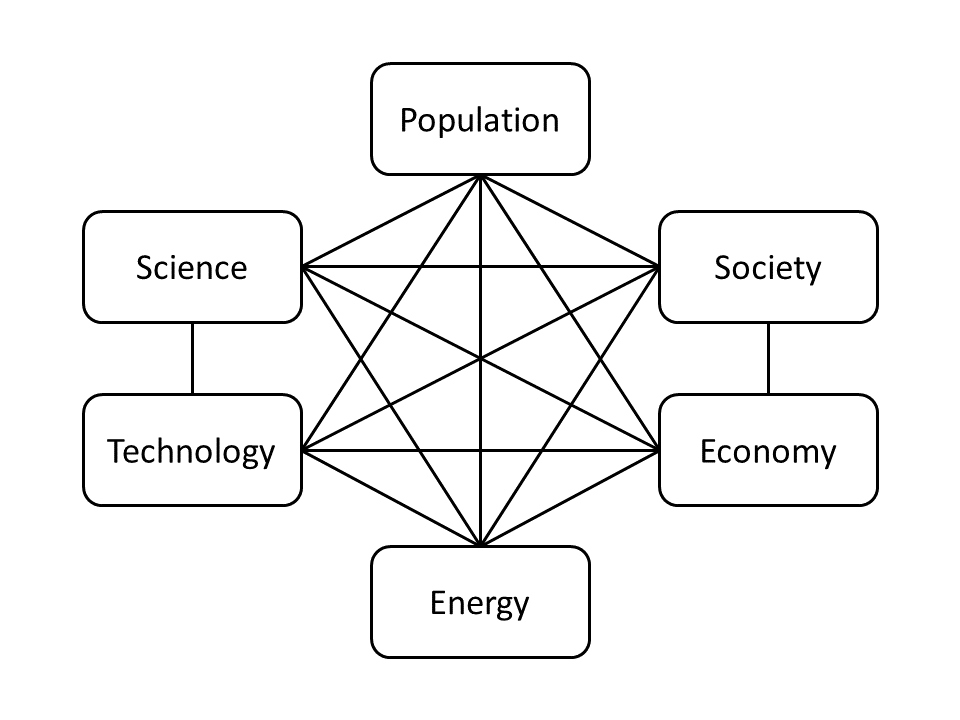
Modern civilization emerged over the last 500 years or so, by a virtuous cycle. This process involved:
- An increase in the human population.
- An increase in economic production.
- An increase in scientific knowledge.
- An increase in technological complexity and power.
- An increase in energy extraction.
- An increase in social complexity and scale.
These things increased together, because each enables the others.
Population and economy are interdependent. A large population requires a large economy to support it. A large population makes a large economy possible, if sufficient natural resources are available. The bigger the economy, the more it can use specialized labor, specialized production processes, and physical capital, such as factories. Mass-production is only efficient if the products can be sold into a large market. So, as the population and economy grow in size, the economy also grows in complexity and efficiency.
Science and technology depend on the scale of society. A large society can afford to invest in advancing science and technology, because the costs and benefits are distributed to more people. It can afford the specialized labor of scientists and engineers. Complex technology requires a large economy to efficiently produce its components, such as high-quality steel, precisely machined gears, or silicon chips. Knowledge is a type of capital, and it becomes more efficient at larger scales.
Science and technology also depend on each other. Scientific knowledge can be used to design technology, and technology can be used to advance science. For example, the science of optics enabled the technology of lenses, and lenses enabled the study of biology and astronomy. Science also depends on communication technology, such as the printing press, for sharing ideas.
Advances in science and technology enable a larger population and economy. New technology enables us to use new resources. For example, steam engines made it possible to convert the energy of coal into mechanical work. Advances in medicine and hygiene reduced disease, increasing lifespans and making it possible to live in large cities. Science and technology enable greater food production. In the 20th century, tractors made farming more productive, while the Haber process enabled the mass-production of nitrate fertilizers.
As the population and economy increase in scale, social complexity also increases. A larger society requires more complex governance, and it can support a larger bureaucracy, which is another type of specialized labor. The bureaucracy depends on technology for communication and record-keeping. The state often supports scientific and technological research. The state also typically funds large infrastructure projects, such as roads, canals, ports, etc. Infrastructure is scale-dependent, because the costs and benefits are distributed over the population.
Trade is an important type of social and economic complexity. Trade within societies and between societies increases the scale and efficiency of the economy. Trade allows goods to be mass-produced in one place and consumed in other places. Trade depends on government services, such as laws, law enforcement and dispute resolution. It often depends on complex technology for long-distance transport and communication.
Energy is a necessary input to biological and social processes. New types of energy, such as fossil fuels, allow the economy and population to expand. New technology is required to exploit new energy sources, and new energy sources make new types of technology possible. Coal makes steam engines worth producing. Steam engines make coal worth extracting. Today, we use very complex technology to extract oil from deep in the Earth. That oil powers the complex technology that makes modern civilization possible.
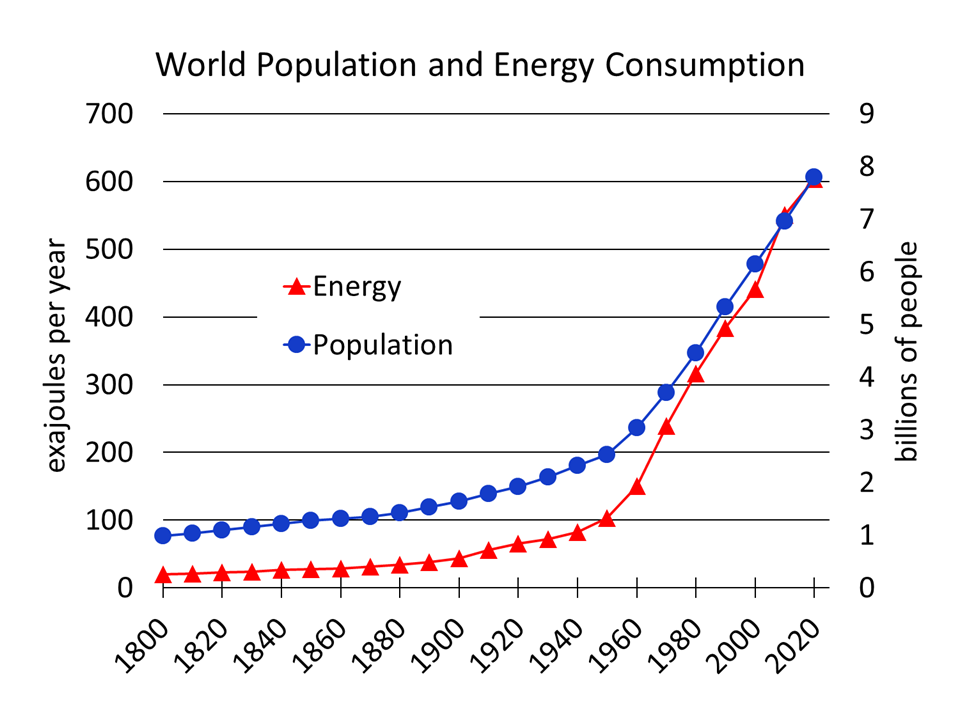
Source: Our World in Data
Each aspect of modern civilization depends on the other aspects, and they all emerged together by a feedback loop.
Our culture has a myth that history is a march of progress, and that progress is generated by human intelligence. Most people believe that advances in science and technology created modern civilization. The truth is that the components of modern civilization emerged together, as a complex system. Each component depends on the others. Growth in each component enabled growth in the others.
The expansion of wind power was an early stage of modernization. Europeans invented sailing ships that could extract more work from the wind than earlier sailing ships, which required oars as a secondary power source. The new sailing technology, coupled with advances in scientific knowledge, enabled global exploration and trade. Europe became the hub of the world in the 1500s, connecting Asia with the Americas by ship transport. Wind power was also used to drain swamps in the Netherlands, producing more food to feed a growing population. This new energy source increased the economic output of Europe, by increasing agricultural production at home, and by enabling trade.
Trade increases economic efficiency, by enabling the regional specialization of production. Raw materials can be extracted in one region and traded to other regions. Goods can be mass-produced in one region and shipped to other regions. Trade increases the size, complexity and efficiency of the economy.
Increased economic production enabled population growth. New crops, such as the potato, were imported from the Americas to Europe. This also increased total food production. Fish were harvested in the Grand Banks off Newfoundland and shipped to Europe. This added important protein and vitamins to the diet of Europeans, improving health and reducing child mortality.
After contact with Europeans, the native population of the Americas suffered from waves of disease, causing a population collapse. The depopulated lands were then colonized by Europeans, who extracted raw materials locally and produced goods for export, such as cotton, sugar and tobacco. There was a population explosion of Europeans in the Americas, due to abundant food and better living conditions.
Meanwhile, the printing press led to the Protestant Reformation and the wars of religion in Europe. That caused an outflow of refugees to the Americas, such as the Mayflower pilgrims. The printing press also led to an expansion of science, philosophy, literature and other intellectual endeavors. It allowed for an increase in literacy and education. As society grew in complexity, there were more jobs that required literacy and education. The production of scientific knowledge became a profession, rather than a hobby. Progress in scientific knowledge led to technological progress, and vice versa.
European states created overseas empires based on trade and colonization, which further increased social and economic complexity. European civilization began to encompass the world. There were large populations of European descent on other continents. Foreign people in distant lands (mostly Asia) also started to participate in European civilization — economically at first, and then culturally. A global civilization was emerging.
Then came the industrial revolution. It had no precise beginning. Mass-production became more important over time, due to increased trade. Factories that were powered entirely by human labor existed before the steam engine. But the steam engine was pivotal, because it used a new source of energy: fossil fuels.
Coal was already in use, along with peat, as an energy source for heating homes. It was a substitute for increasingly scarce wood in Europe, especially in Britain. Coal was also used for making steel. The steam engine made it possible to convert the energy of coal into mechanical work. At first, steam engines were mainly used to transport coal, and to pump water out of coal mines. This led to the invention of steam-powered trains, which could transport raw materials, manufactured goods and people. Railroads enabled economic expansion. Large-scale coal production enabled large-scale steel production, and vice versa. Both enabled and were enabled by long-distance transport, via steam-powered trains and ships. Steam-engines were also used to do various types of mechanical work.
The industrial age had begun.
Electrification was the next major technological revolution. Electricity could be generated from water power, using dams, or from fossil fuels, using steam engines. Either way, it was a very convenient form of energy. It could be precisely and safely converted into mechanical work with electric motors. It could be used to generate light and heat. It could be used for long-distance communication, starting with the telegraph, and later the telephone, radio, television, etc. Electrification increased the use of mechanization in factories. Unlike the steam engine, it also had uses in the home, such as electric lighting and refrigeration. Most of our modern conveniences depend on electricity.
There was another revolution in transportation: the replacement of steam engines with internal-combustion engines powered by oil or its derivatives. Today, most transportation uses some type of internal-combustion engine: ships, trains, cars and airplanes. Oil is a very important energy resource, because it is a liquid fuel with a high energy density. Unlike steam engines, internal-combustion engines require liquid fuel.
During the 20th century, the global population increased from under 2 billion to just over 6 billion. It increased at a decreasing rate, due to declining fertility. The global economy grew faster than the population, causing a general increase in prosperity. Scientific, technological and economic progress continued, although the rate of scientific progress declined in the late 20th century.
See The Rise and Stagnation of Modernity.
Despite the general increase in prosperity, there were some major famines in the 20th century, when population growth outpaced food production in certain areas. The 1932–1933 famine in Ukraine and the 1959–1961 famine in China are two examples. Both were partly due to rapid population growth, and partly due to communist economic policies. Millions died in each.
After 1960, global food production grew slightly ahead of the population, so hunger became less of a problem globally. Yields per acre for important crops, such as wheat, corn, rice and potatoes, increased dramatically in the late 20th century, due to new agricultural methods, increased fertilizer use, and new crop strains. Nevertheless, there were some famines, such as the 1983–1985 famine in Ethiopia and the 1994–1998 famine in North Korea.
The last great technological revolution was the information revolution. Electrical computing and communication technology became much more efficient and compact, due to the invention of the transistor, and later the computer chip. Computers became ubiquitous in business and ordinary life.
Computer chips are a good example of how economic scale makes complex technology possible. Computer chips are manufactured using very complex and precise technology, which can only be produced by a large, complex industrial economy. It also requires a huge capital investment to make a computer chip factory. To be profitable, the factory must sell millions of chips into a large market. Computer chip factories, and thus computer chips, can only exist in a large, complex economy.
In the late 20th century and early 21st century, modern civilization continued to expand on all dimensions. The global population increased. The global economy grew in scale and complexity. Scientific knowledge expanded, although at a slower rate than before. New technologies became widespread, such as the personal computer and the cell phone. Containerized shipping made global trade more efficient. The internet created new forms of communication and commerce. New technologies, such as offshore drilling and fracking, made it possible to extract more oil. Global energy consumption continued to rise. Multinational corporations, such as Apple and Google, became increasingly important in the global economy.
That brings us to the present day. We have a highly complex, highly interconnected, increasingly global civilization, with a population of over 8 billion people, most of whom live in conditions of relative peace and prosperity compared to their ancestors.
Modern civilization is a complex system, which emerged by a self-escalating process. We did not design it, and we do not currently control it. Under different material conditions, it might not have emerged. If it collapses, it might not emerge again.