Population, Fertility and Evolution
Here is a little thought experiment about population, fertility and evolution.
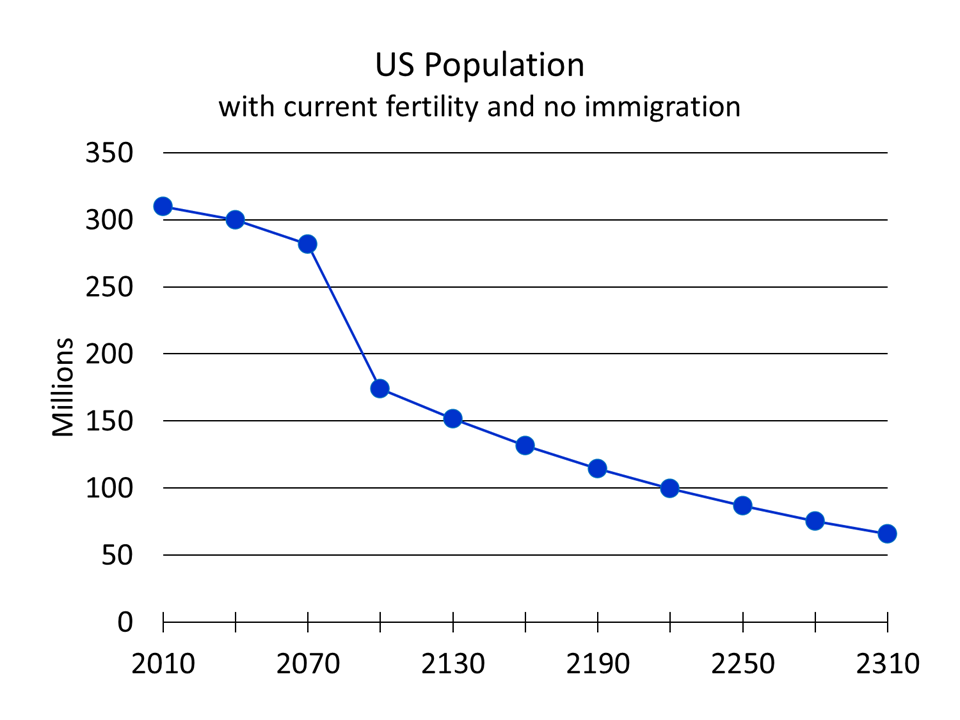
This chart shows how the US population would change if there was no immigration, and fertility stayed at its current (2017) level of 1.82 children per woman. For this thought experiment, the details are not very important, and I was not very careful about them. The chart begins in the past (2010), so it ignores recent population growth. The bulge followed by a rapid drop-off is due to the delayed effect of stopping immigration. Again, the details don’t really matter. What matters is that the US population would decline significantly, from about 310 million to about 65 million in 300 years.
Now, let’s look at another chart.
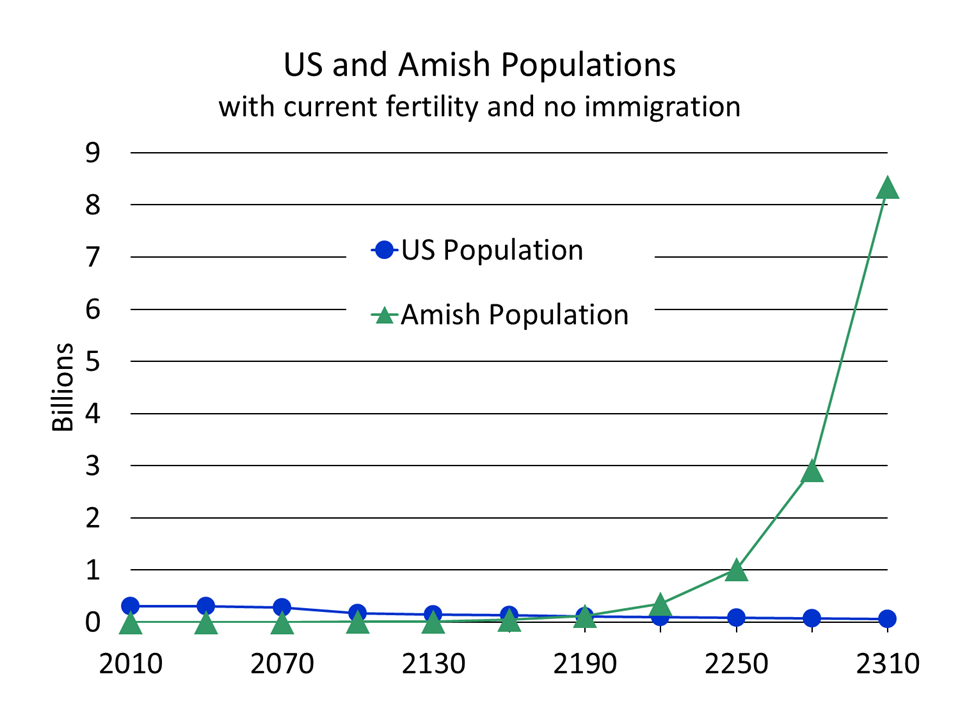
This chart shows how the US Amish population would change during the same time period, if it maintained its current rate of growth. Currently, the Amish population is growing rapidly. It takes about 20 years to double in size. It has low out-migration and even lower in-migration. It grows by reproduction. Again, the details aren’t that important. What matters is the overall shape of the curve. The Amish population would grow exponentially from an initial population of about 230,000 in 2010 to over 8 billion in 300 years.
There is a glaring contradiction here. In this thought experiment, the US population declined to about 65 million, while the US Amish population grew to over 8 billion. That is impossible, because the US Amish population is a subset of the US population, and thus it cannot be bigger than the US population. Obviously, there was a flaw in the premises of the thought experiment. What was it?
The flaw was the assumption that the US fertility rate and the US Amish growth rate could both stay fixed during the experiment. The high growth rate of the Amish is due to their high fertility rate. If they maintain their current rate of growth while the rest of the US population declines, then the Amish will increase as a percentage of the US population, and that will drive up the US fertility rate. The average US fertility rate cannot stay fixed if the Amish maintain their current rate of growth.
The Amish are currently about 0.07% of the US population. Their high fertility has very little effect on the average fertility of the US today, but it could have a very big effect on the future population of the US. For the sake of argument, suppose that the Amish maintain their high fertility, while the rest of the US population maintains a low fertility of 1.82 children per woman. In that case, it would take the Amish about 180 years to become the majority of the US population. After that, they would become the overwhelming majority very quickly.
We usually ignore outliers, but outliers cannot be ignored when predicting how populations will change. The Amish are a tiny outlier population in the US today, but evolution can turn the exception into the rule. Even though the US population has below replacement fertility, it also contains the potential for explosive growth.
The future isn’t determined by today’s averages. What is abnormal today could be normal in the future, and vice versa.
Human nature varies between individuals and across time. The Amish are not the only outliers in the US population. They are just an easily identifiable subset with above average fertility. In spite of its low average fertility, the US population contains many people who have 3, 4, 5, 6 or more children, for a variety of reasons. Those people are not randomly drawn from a fixed distribution of human natures. They are born. They inherit traits from their parents. They pass traits on to their children. In the modern environment, any trait that increases fertility is selected for. Being Amish is a complex trait that passes from parents to children. Because it increases fertility, it is selected for. You might not think of that as evolution, but it is. It is a change in a population due to different rates of reproduction.
Being Amish is mostly a cultural trait, but it could be partly biological too. Certain personality traits could make people more or less likely to stay in the Amish faith, and personality traits are highly heritable. Over the centuries, those who found the Amish faith unappealing left it behind, and that selected for certain personality traits within the Amish population. Today, most children who are born to Amish parents keep the Amish faith and have children of their own. Being Amish is a gene-meme complex. It is mostly cultural, but not entirely, and it is passed from parents to children.
There are many other little fertility cults in the US population. Some are religious. Some are just single individuals who, for whatever reason, have more than 2 children. People with above-replacement fertility increase the frequency of their heritable traits in the population. Traits that cause higher fertility will increase in the population, unless they have negative effects that outweigh the positive effect on fertility.
It doesn’t matter what those traits are. It could be something as complex as being Amish. It could be simply the idea that having kids is a good thing. It could be an allergy to the birth control pill. It could be low IQ, low impulse control, or psychopathy. Any heritable trait that causes people to have more surviving children will increase in the population.
That’s why you can’t treat the US population as an undifferentiated mass when reasoning about its future. The same is true of the world population. Outliers matter. You can’t assume that human nature is invariant. It varies between individuals, between subpopulations, and over time. Evolution is always acting on the human population and on human nature. And that’s why you can’t predict the future from the averages of today.
Let me be clear. I am not saying that the future will be overwhelmingly Amish. It could be, but I believe that other things will happen to prevent that outcome. I am saying that you can’t predict the future by simply extrapolating current behavioral trends into the future.
These days, most people believe that the problem of population growth will be solved by a shift to low fertility. Demographic transition theory claims that modernity (especially increased wealth) lowers fertility, and thus if we raise the living standards of high-fertility populations in Africa and the Middle East, their fertility will decline and overpopulation will cease to be a problem, forever. This view is popular among academics and experts. It is generally accepted. But, like many popular beliefs, it is false.