The Sexual Revolution
A l’exemple de Saturne, la révolution dévore ses enfants.
— Jacques Mallet du Pan
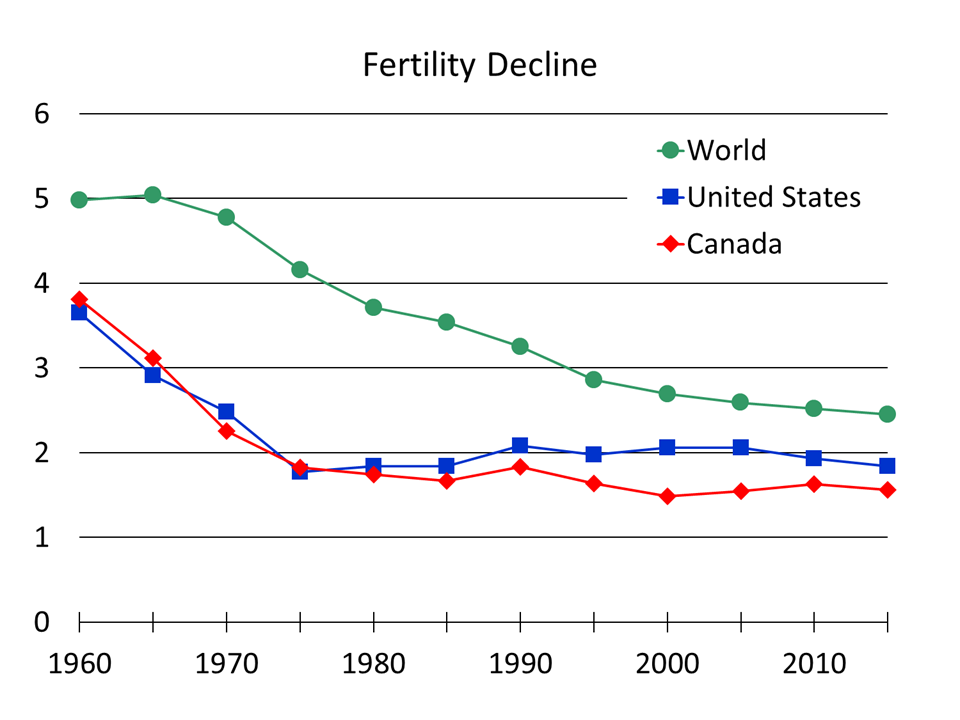
Something happened in 1960. Fertility rates began a precipitous decline, especially in the West. In the United States, fertility fell from a peak of roughly 3.6 in 1960 to a low of roughly 1.7 in 1975. The same pattern occurred in other Western societies. Today, most of the developed world has below replacement fertility. Without immigration, the population of Europe, the United States, Canada, Australia and New Zealand would be falling.
What was the reason for the huge drop in fertility? The simple answer is the birth control pill. The more complex answer is modernity.
The birth control pill was part of a larger transformation of culture and society, which included:
- The breakdown of traditional norms about sex, marriage and family.
- The replacement of traditions with popular culture (fashions).
- Increased urbanization.
- Increased participation of women in the work force.
- Concern about overpopulation and the environment.
The birth control pill accelerated a revolution that was already in progress. The modern way of life was centered on the individual, as a worker and consumer, rather than the family. Industrialization and urbanization created new jobs that could be filled by women. Instead of getting married at an early age and starting families, the young were encouraged to prolong adolescence and pursue personal development and experiences. Fertility declined as a result. People chose to have fewer children. The birth control pill made that choice much easier.
A Very Brief History of Reproduction
Before the industrial revolution, life was harsh. Most children died young, before they had a chance to reproduce. Premature death limited the population and shaped biology and culture.
The industrial revolution caused a huge decline in child mortality, and a rapid growth in the human population. New farming technologies and methods increased food production locally. Global trade created a global economy that could produce everything more efficiently. Fossil fuel energy powered both. Modern medicine and hygiene cured or prevented many deadly diseases. The industrial revolution created prosperity and longevity.
The sexual revolution was the counterpart of the industrial revolution. The industrial revolution lowered child mortality. The sexual revolution lowered fertility.
The sexual revolution can be viewed in two ways:
- Liberation: The sexual revolution liberated people from the constraints of the past. The birth control pill gave people more control over their lives. They consciously chose a new way of life, which was enabled by modernity.
- Pathology: Low fertility is a pathological response to the conditions of modernity, caused by a misfit of the human brain to the modern environment. Low fertility is maladaptive, especially in conditions of low child mortality.
Both views are correct. Low fertility is a type of liberation from the conditions of the past, and it is a pathology of the modern world. It is a pathology caused by liberation.
The Modern Human Condition
The birth control pill disables the female reproductive system. It conveniently and reliably prevents conception with little effect on the pleasure of sex. It decouples the subjective experience of sex from the objective function of sex: reproduction.
Using birth control is analogous to putting a car up on blocks, so the wheels don’t touch the ground. The wheels still spin, but they don’t propel the car forward. With birth control, sex still feels good, but it doesn’t lead to reproduction. Birth control is a kind of “free lunch” scheme. It is an attempt to get the pleasure of sex without the cost of raising children. Like most free lunch schemes, it has unintended consequences.
Your emotions don’t exist to make you feel good. They exist to motivate action, and ultimately to make you reproduce. Reproduction is the biological purpose of life, so every emotion has been selected to have a positive effect on reproduction. Sex feels good because sex causes reproduction.
People want sex, but they don’t want children very much — at least, not until they have them. There is a good reason for this. If people wanted children instead of sex, they might be motivated to kidnap children rather than procreate. The function of lust is to make you have your own children. When your children are born, then you naturally become attached to them and want to take care of them. We have the emotions that make us bond to children once they are born, but we don’t have emotions that make us want to have children. Instead, we have emotions that make us want to have sex.
As a result, when people have effective birth control, they choose to have fewer children than would be adaptive. In the modern environment, there is no reason to limit fertility. In fact, the opposite is true. Thanks to modernity, almost all children live to adulthood. Thus, the best reproductive strategy is to have as many children as possible. But our desires didn’t evolve in the modern environment of abundance and birth control, so people don’t make adaptive choices in this environment. Instead, they tend to have few children.
Birth control disconnects our sexual emotions from their natural functions and short-circuits them. This makes our behavior maladaptive. It seems to make life easier, but it does so by eliminating the purpose of life: reproduction. Life is easier when it has no purpose.
Adapt or Be Replaced
Low fertility cannot last forever, because it is self-eliminating. Low fertility selects for high fertility.
People are not all the same, for various reasons. There are genetic and cultural differences that affect reproduction. Some people have more children than others. Those who reproduce tend to pass on whatever traits gave them higher fertility. The genes and memes of people who choose to reproduce will replace the genes and memes of those who do not.
The low-fertility lifestyle is like a new disease that is spreading through the human population. Humanity will eventually develop resistance to this disease. While the meme of low fertility continues to spread, it also selects for traits that cause higher fertility. It selects against those who are infected by it.
The future belongs to those who show up.
Case Study: Ultra-Orthodox Jews
The ultra-orthodox Jews are an interesting example of a successful cultural adaptation to the modern world. Most of them live in Israel. They have high fertility: roughly 6.5 children per woman. So, their population is rapidly increasing. It doubles in less than 20 years.
Their high fertility is due to religious restrictions on birth control, combined with a family-oriented way of life. They maintain their way of life by self-segregation. They create separate communities. They dress in a distinctive way, which sets them apart. They have separate schools. They view themselves as superior to other Jews. However, they also take advantage of the larger society in which they live. Many receive welfare payments or other state subsidies. The men reject military service, but they receive the protection of the state. They live within modern civilization, but refuse to integrate into it.
Ultra-orthodox Jews are rapidly increasing as a percentage of Israel’s population. They also have growing communities in the United States and other countries.
Case Study: The Amish
The Amish are a religious group of Anabaptist Christians, found mostly in the United States. They practice a traditional farming lifestyle, and they reject most modern technology, including birth control. They can be seen driving horse-drawn buggies down country roads in rural Pennsylvania, Ohio, Maryland and New Jersey. Their population is growing rapidly, and they are expanding to other parts of the country. Ironically, their archaic way of life makes them well-adapted to modernity.
The Amish marry young and have many children per family. At their current rate of growth, their population doubles every 20 years, roughly speaking. That growth is almost entirely due to reproduction. Very few people join the Amish community as adults. On the other hand, there few defectors. Most people born into the Amish community stay in it. That could be due to selection: traits that make people likely to leave the religion have already been removed from their population.
There are about 250,000 Amish people today. At their current rate of growth, the Amish population would reach roughly 8 billion in 300 years. That is more than the current world population.
The Future of Modernity
Because of differences in fertility, the human population is becoming:
- More African, less European.
- More conservative, less liberal.
- More religious, less secular.
- More psychopathic, less socially responsible.
- Lower IQ.
- Less capable of maintaining modern civilization.
In the humanist worldview, low fertility is a type of progress. It prevents the problems of overpopulation and scarcity. It also liberates people from the burden of parenting, and allows them to actualize their potential as human beings.
Many people believe that low fertility will spread to all of humanity, and solve the problem of overpopulation. This belief is formalized in “demographic transition theory”, which predicts that populations transition from high to low fertility as they modernize. This prediction is built into UN population projections.
Demographic transition theory is based on false assumptions about human nature. It doesn’t take evolution into account. It assumes that human nature is fixed and universal, and thus all humans will respond to modernity in the same way: by lowering their fertility. It also tacitly assumes that human nature is self-regulating, so it will not produce a population explosion. In this view, if child mortality declines, then people will adjust their fertility downward. This is not true. No species evolved, or could evolve, to regulate its own population. Populations are regulated by scarcity and competition, and they are limited by premature death, not by voluntary low fertility.
I have already given some examples of human populations that have persistent high fertility. There are also differences between individuals. Some people have many children. Some have none. In the modern environment, high fertility is adaptive. Any trait that causes high fertility will be selected for. Low fertility cannot persist, because it is maladaptive. As long as child mortality is low, high fertility will be selected for.
There are various cultural and biological traits that increase fertility, such as having certain religious beliefs, wanting children, being impulsive or irresponsible, and being allergic to the birth control pill and/or latex. Such traits will increase by reproduction. High fertility populations, such as the Amish, Orthodox Jews and fundamentalist Muslims, will increase relative to the total human population, and become more culturally and socially important.
Modern civilization has profoundly changed the conditions of human life. By doing so, it has changed the selective pressures on our biology and culture. New adaptations will arise in response to those pressures.
Overpopulation can’t be solved by people voluntarily choosing to have few or no children, because that behavior is selected against. Social problems cannot be solved by individual altruism. They can only be solved by collective action, such as social controls on reproduction.
Modern civilization, in its current form, is not a stable, long-term solution to the problem of human existence. It feeds on a finite stock of fossil fuels, and it feeds on the people who created it and sustain it. If we don’t fix the problems with our civilization, it will eventually destroy itself, and we will return to the premodern condition, in which high fertility is balanced by high child mortality.