The Demographic Tsunami
Written in June, 2023.
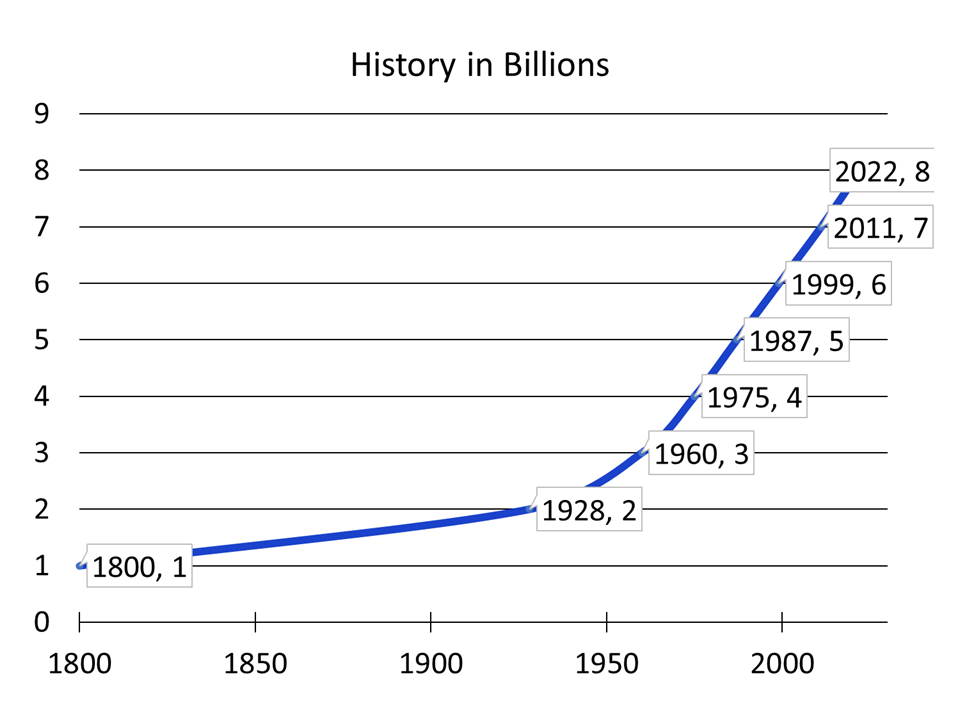
According to most estimates, the human population passed 8 billion in late 2022.
Since about 1970, the global population has been growing linearly, increasing by 1 billion every 12 years or so. During that period, the fertility rate declined while the population grew. The result just happened to be roughly linear growth.
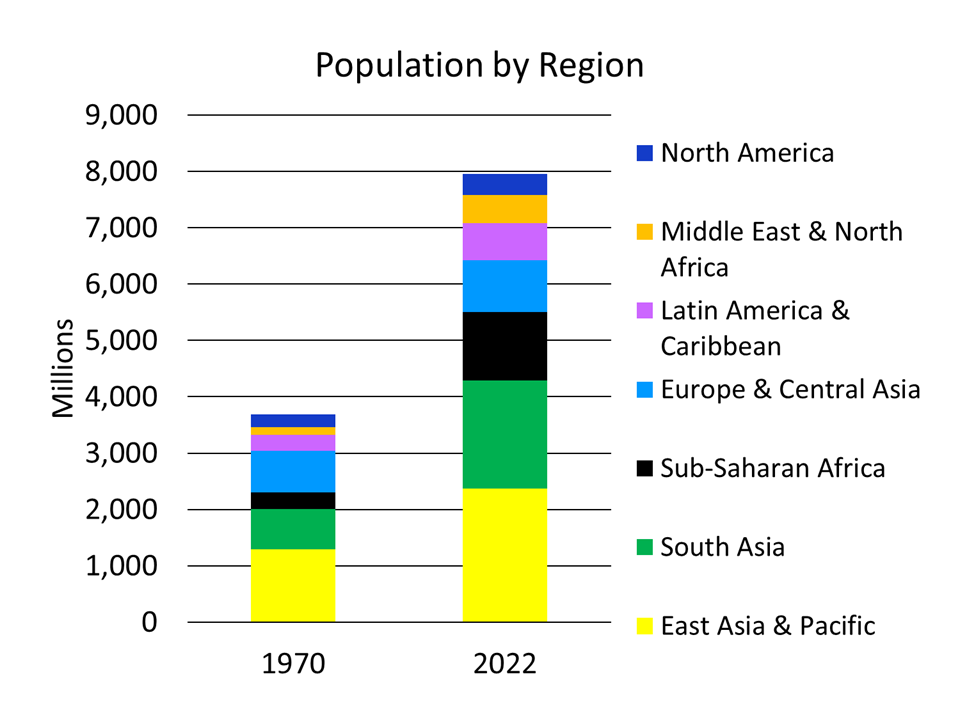
The preceding chart shows the populations of major geographical regions in 1970 and 2022. East Asia & Pacific is the largest region, followed by South Asia. Together, they contain more than half the world’s population. North and South America together contain only about 13% of the world’s population.
Population growth was not uniform. Some regions grew more than others, proportionately. Demographically, the world is a very different place today than it was in 1970.
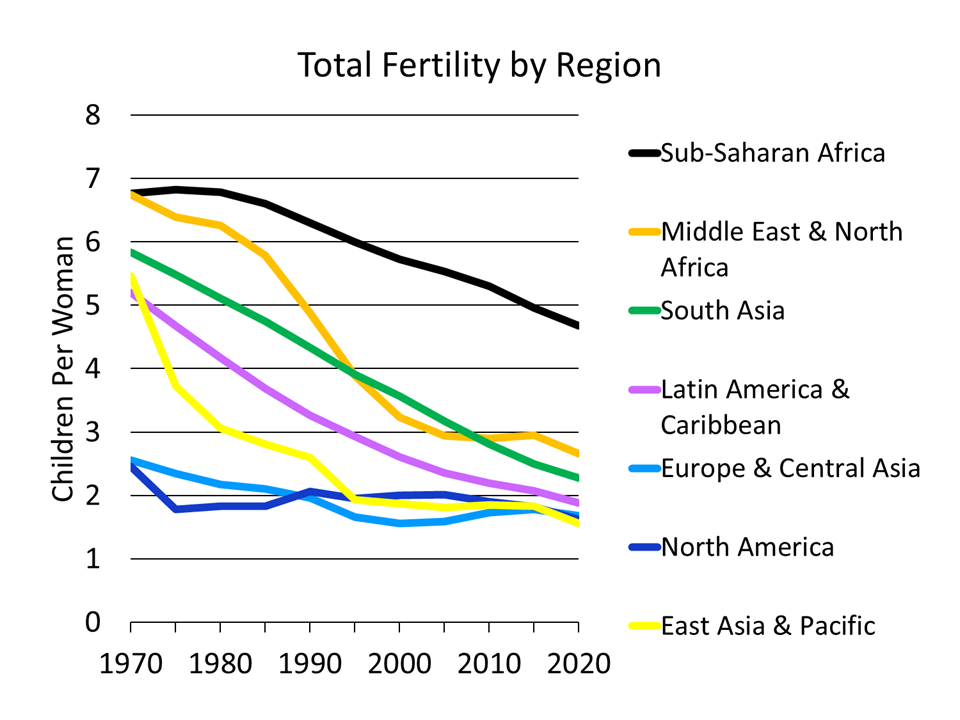
Differences in fertility were the main cause of the differences in population growth. The preceding chart shows total fertility (children per woman) by region, for the period 1970 to 2020. There has been a general decline in fertility, but some regions declined more than others, and some started with higher fertility than others. Even without immigration, a population can continue to grow for decades after fertility has fallen below replacement, due to demographic momentum.
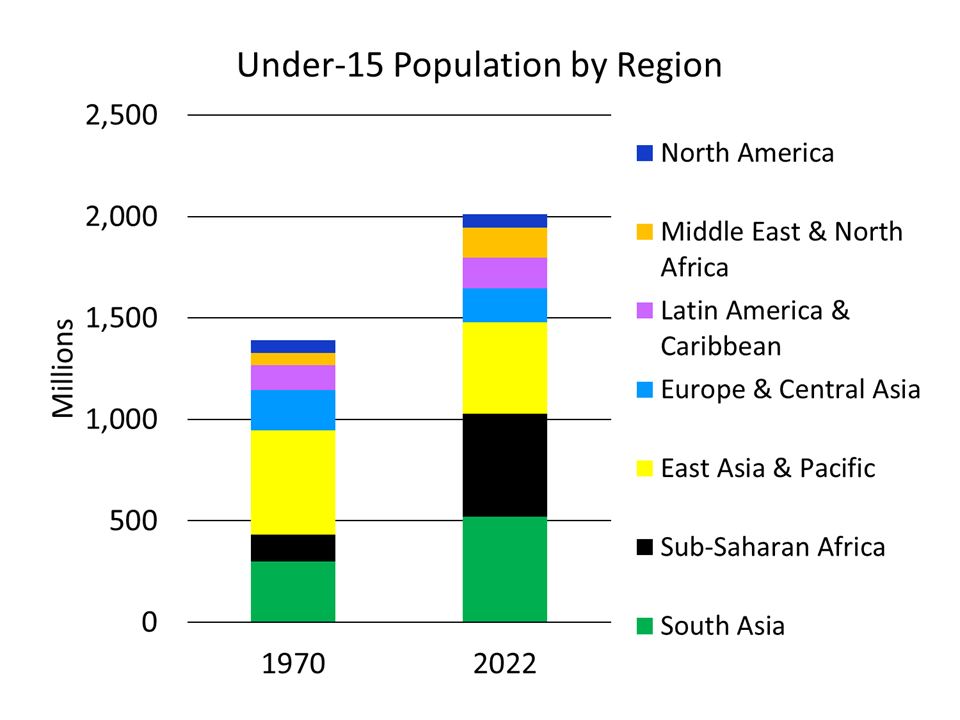
The preceding chart shows the population of children (under 15 years old) by region in 1970 and 2022. South Asia has the largest child population, followed closely by Sub-Saharan Africa. Together, they have more than half the world’s children. Europe & Central Asia and East Asia & Pacific have smaller child populations today than they had in 1970.
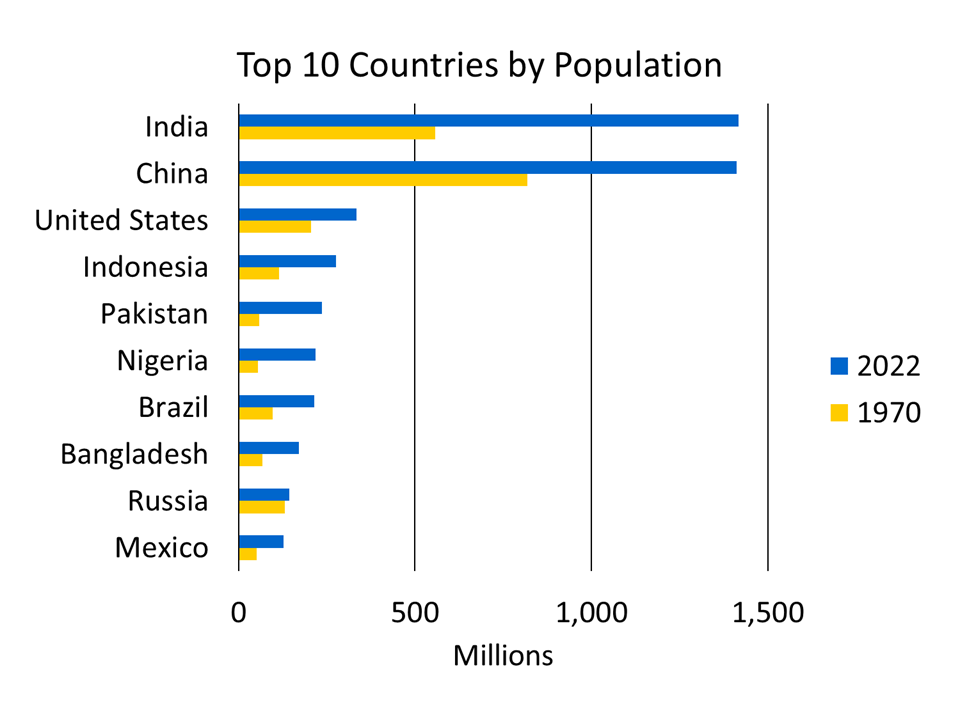
The preceding chart shows the 10 countries with the largest populations in 2022, and their populations in 1970. China and India are the largest countries in the world by population, with over 1.4 billion people each. The United States is a distant third, with roughly 335 million people.
In 1970, the global population was less than half of what it is today. China and India were the biggest countries. The Soviet Union was third, with about 240 million people. However, the Russian part of the Soviet Union was significantly smaller than the United States. By itself, Russia was fourth. The United States was third. Indonesia was fifth, at less than half its current size. Japan was sixth, with 103 million people. The other countries were Brazil, Germany, Bangladesh and Pakistan, all with populations below 100 million. Since 1970, Japan and Germany have dropped out of the top 10, replaced by Mexico and Nigeria.
Among the current top 10, Nigeria and Pakistan had the biggest proportional increases. Both were almost four times larger in 2022 than in 1970. India, Indonesia, Bangladesh, Mexico and Brazil more than doubled. The United States increased by 63%. China increased by 73%. Russia had the lowest proportional growth, increasing by only about 11%. The Russian population is currently in decline.
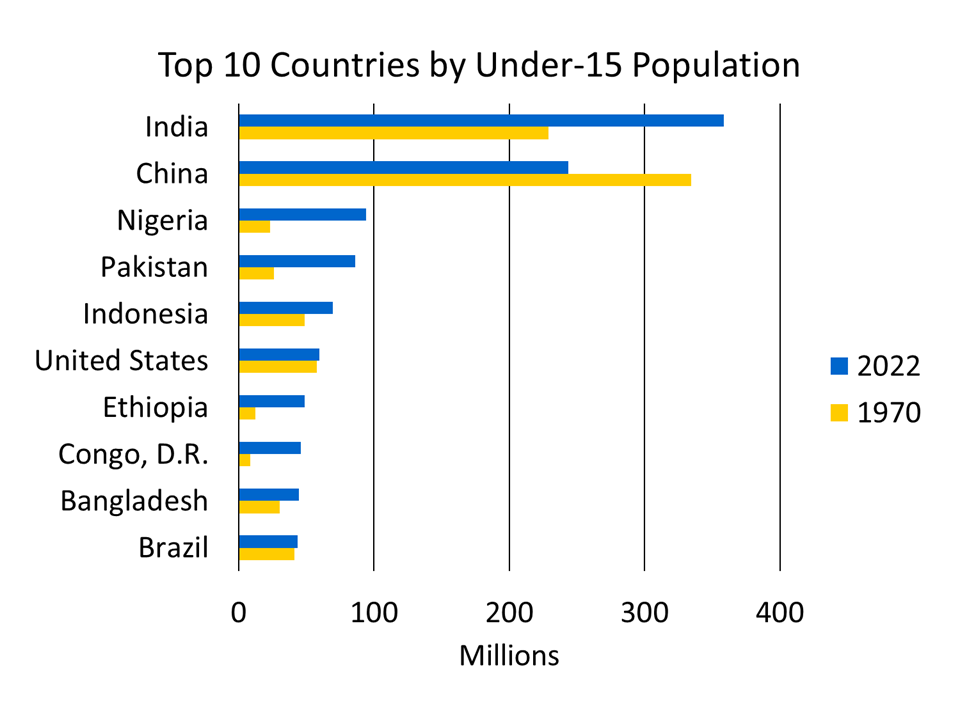
The preceding chart shows the top 10 countries by child population. It is significantly different from the top 10 countries by total population. India has many more children than China. Instead of third, the United States is sixth, after Nigeria, Pakistan and Indonesia. Ethiopia is next on the list, even though it is not in the top 10 by total population. Congo D. R. also makes it onto the list.
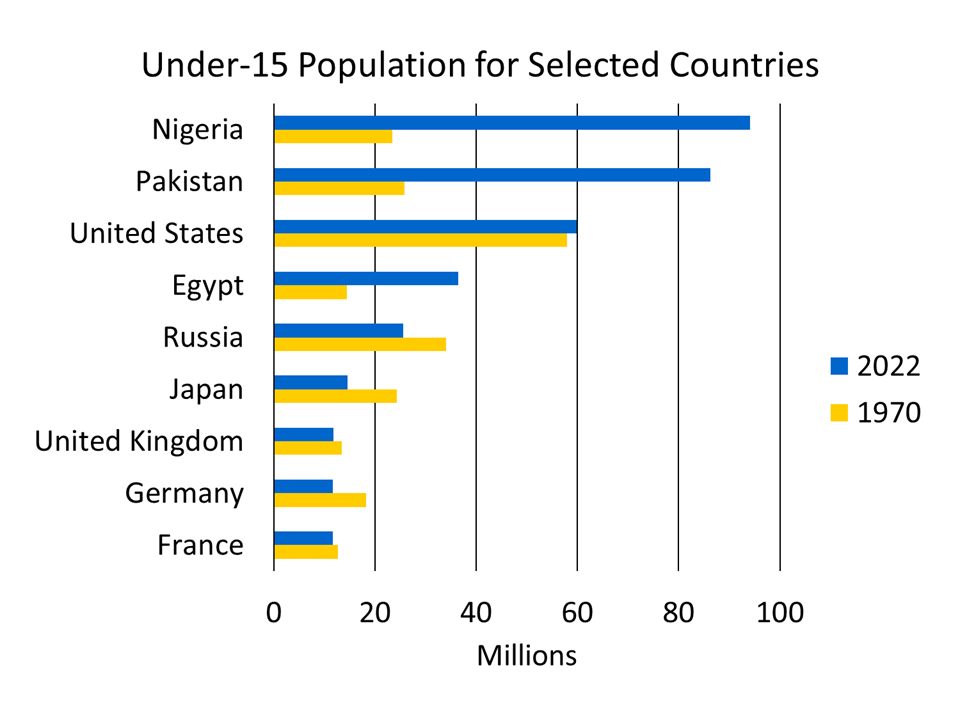
Some countries that were very important in the past, such as Russia, Japan, the United Kingdom, France and Germany, are fading into global insignificance demographically. Nigeria alone has more children than all of those countries together. So does Pakistan.
High fertility countries, such as Nigeria and Pakistan, have rapidly growing child populations. Countries with low fertility and low immigration, such as Russia and Japan, have declining child populations. In the United States, the child population has been roughly steady, despite an increasing population due to immigration. The same is true of the United Kingdom. Even with immigration, Western countries have aging populations.
Most people know that the global population is growing, but few appreciate how much its composition has changed. For example, most people are shocked to discover that Nigeria has a bigger population than Russia. The composition of the world’s population is changing geographically, racially and culturally.
These demographic changes will have a big impact on the future of the world. Life will get harder as the global population increases and fossil fuels are burned up. The hardship will be worse in the more populous and less-developed parts of the world. There is likely to be mass migration from those regions to the richer parts of the world, especially Europe.
In the past, the developed world could afford to bail out less-developed countries during hard times. For example, Western countries sent a large amount of aid to Ethiopia in 1985, to help deal with famine conditions. At the time, Ethiopia had about 40 million people. Today, it has over 120 million people. It would be much harder for the West to help Ethiopia today. The same is true for other countries that are economically fragile and have large populations, such as Pakistan. If they collapse, it will be hard to bail them out or absorb the refugees.
The future is determined by who shows up. The population explosion in the less-developed parts of the world is a demographic tsunami that will sweep over the world and profoundly change it.
Sources